The Solid Foundations Course

The Solid Foundations Course is designed as a starting point for anyone yearning to explore the depths of their spiritual life. If you’ve established the basics of faith – attending Sunday Mass and praying regularly – and now find yourself asking, “Is there more?” or “How can I grow closer to the Lord?” then this course is for you.

This course is ideal for those seeking to:

  • Build a more profound and personal connection with the Lord.
  • Lay a strong foundation for spiritual growth, guided by the wisdom of the Church’s great spiritual writers, including St. John of the Cross, St. Teresa of Avila, and St. Thérèse of the Child Jesus.

The Solid Foundations Course provides practical knowledge and guidance to help you deepen your spiritual journey. You’ll gain insight into two transformative forms of prayer:

  1. Lectio Divina
    • Learn to listen to God through Scripture.
    • Discover how to integrate His Word into your daily life.
  2. Prayer of the Heart
    • Connect with God on a deeper, more intimate level.
    • Experience His nourishment and presence through contemplative prayer.

These practices extend and enrich the graces of the Mass, helping you “digest” God’s Word and live the Eucharist in your daily life.

  • Rich and Practical Content: A detailed exploration of spiritual growth and prayer practices.
  • Climate of Prayer: Sessions foster silence, recollection, and deep reflection.
  • One-on-One Guidance: Participants can ask questions and schedule private online sessions with the instructor.
  • Certification: Completion certificates awarded – no exams, no essays, just commitment to the journey.
  • Accessible to All: No prior courses are required to enrol.

This course has been developed with the approval and blessing of H.E. Peter Smith, Archbishop of Southwark, UK. As with all School of Mary programmes, Our Lady, Mother of Jesus, is the Patroness of this course.

The course fee is $280 / £210 / €240.
We are committed to making spiritual formation accessible, so please reach out if financial concerns arise.

You can take this course as a pre-recorded, on-demand programme. To enrol:

  1. Send us an email explaining your interest in this course.
  2. After confirmation and payment, you’ll receive access to the course playlist.
  3. You’ll have the opportunity to email questions and request additional one-on-one support sessions with the instructor.

Part 1: Introduction & Lectio Divina

  • Introduction to Spiritual Life: Its goals and stages.
  • Lectio Divina: Listening to God’s Word and applying it to life.
  • Guided sessions and insights into biblical interpretation.

Part 2: General Laws of Spiritual Life

  • Understanding the dynamics of faith, hope, and love.
  • Recognising and navigating spiritual challenges.
  • Exploring Christ and the Holy Spirit roles in spiritual transformation.

Part 3: Prayer of the Heart

  • Introduction to contemplative prayer: History, method, and practice.
  • Practical guidance on focusing the mind and heart on God.
  • Exploring God’s action and response in prayer, including the “Prayer of Quiet.”

For a detailed syllabus, see here or contact us directly at contact@schoolofmary.org

This course is more than an introduction – it’s an invitation to encounter God in a transformative way. Lay the foundation for a lifetime of spiritual growth and intimacy with the Lord.

Contact us at: contact@schoolofmary.org

The Deep Meaning of Christmas

Now, when we talk about the second coming of Jesus in our heart (see previous post), a hidden coming, this gives us the deepest insight on the Grace of Christmas.
The Lord alludes to his mysterious coming in our heart during the last supper:
“Whoever has my commands and keeps them is the one who loves me. The one who loves me will be loved by my Father, and I too will love them and show myself to them.” (John 14:21)
“Anyone who loves me will obey my teaching. My Father will love them, and we will come to them and make our home with them.” (John 14:23)

The message is clear and all Spiritual Masters dedicated their life to this endeavour: to receive Jesus during this lifetime in their heart in fullness (as much as it is possible here on earth). Many called it: “Union with God” or “Union with Christ”, others: “Spiritual Marriage”. (One can read what St Thomas Aquinas says in the Summa Theologica about the invisible Missions of the Son and the Holy Spirit, in the first part of the Summa, q. 43.)
Now, more precisely, liturgically God gives us every year a powerful grace for Christmas, a grace that manifests in the most clear way His Mercy for each one of us. Because through Christ’s birth, the Incarnation (which Christmas celebrates) is the decision that God the Father took, out of an immense and unique personalised love for each one of us, to get closer to us, to the point of uniting himself not only to our nature but also to specifically each one of us.
The Birth of the Messiah, King and Saviour of each one us manifests in a most pure way the Mercy of God! We were sinners, we were walking (and still are) in the land of the dead and of Darkness (Isaiah 9:2), and we didn’t even know what Light is, and The Eternal Light, because of His very nature who is Tender Love, decided that it was time to come and unite himself to each one of us.
Each year, we celebrate this unique event in History, and it is Christmas. God continues to offer us this same grace he already gave us 2000 years ago, and he showers every year amazing graces of conversions, of liberation for various types of “slaveries”, addictions, darkness, sins, mortal sins,…
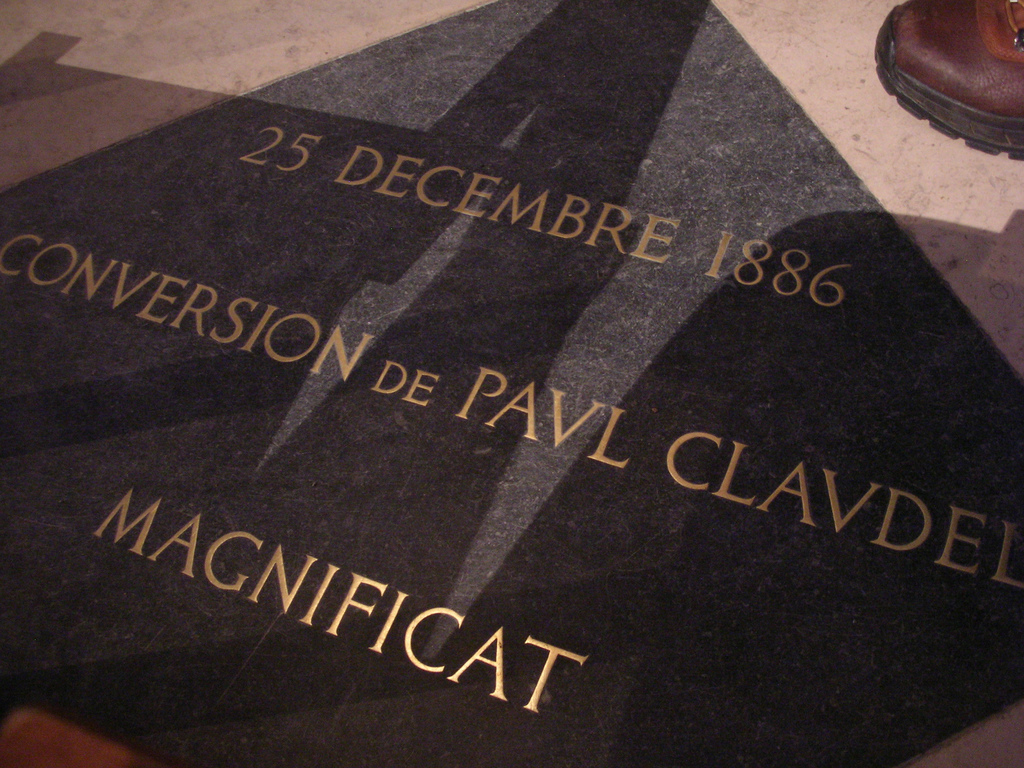
The last two centuries saw many big conversions happening during Christmas Eve Mass. Remember Paul Claudel, the French poet: he entered at midnight Mass at Notre Dame’s Cathedral, in Paris, he entered atheist and came out after the Midnight Mass a fully Catholic Believer. You can still visit the spot where he was standing, following the right nave, quite ahead. This is just an example of the power of the Grace of God.

Historic floor plaque, site of Paul Claudel conversion, Notre Dame

St. Therese of the Child Jesus had a powerful healing from a very painful deep crisis of scruple: she was pre-adolescent. It was during Christmas.
Each one of us should be totally convinced that the Lord has an amazing Present for him every Christmas, a powerful and beautiful grace to receive. Not necessarily visible to others, but “visible” to ourselves. It is something along the line of the mysterious coming of Jesus in our heart. Some spiritual masters even consider that Christmas is the most appropriate liturgical time to mark the spiritual turning points (think for instance the end of the purification, or the Grace of Union with God (Spiritual Marriage)).
Now do we only think about ourselves?

It is important to join Mary in her understanding and perception of what is happening: the meaning of the Coming of our Saviour. The reason why he comes is to save us, to take us from the Darkness to his Light, to unite us to him! Mary today is aware of all the persons who need her Son, the Holy Spirit working in her heart freely, deeply totally and powerfully, moves her to Desire the Salvation of the World, the Salvation of each person, especially the ones who need most God’s Mercy. This is the Prayer that the Holy Spirit generates in the depths of Our Lady.
We need to joint into this prayer and make space in us for Our Lady and the Holy Spirit in our heart, so we participate this way to the coming of the Saviour for our brothers and sisters who are in need of Him (and they don’t know it).
It is by offering sacrifices, little ones, not ostentatious ones, just visible to God, offering them to God, to the Holy Spirit so we can help in the work of Salvation of our Brothers and Sisters. Prayer and Sacrifice offered to the Fire of the Holy Spirit are a very important contribution to Christmas Grace!
A sacrifice of patience, of forgiveness, of offering what pains us, of offering even our joys, so the Lord Holy Spirit takes all this and transforms it in his Power of Salvation for the benefit of our Bothers and Sisters.
Not only we can contribute in the salvation of the World, we should be worried and busy with it, having it at the centre of our heart! Our brothers and sisters are Jesus’ body. The ones who are far, and live in the darkness are the ones who generate most Mercy and humble compassion in our heart, we are moved by seeing their state, being far from God, we suffer because of this, we want things to change! We offer all of this to the Fire of the Holy Spirit acting in Mary, waiting for Jesus to be Born giving a grace to our brothers, a Salvation Grace, a Grace of Mercy.
Let us contribute to the salvation of Jesus’ Body, our brothers and sisters!
Prayer and Sacrifice, real love of our “enemies”, of what is “unpleasant”, of what contradicts us… offering it to the Fire of the Holy Spirit, to Our Lady… this is the most important contribution we can give for Christmas! This is to love Jesus.

See also:

Jesus is born in our heart
This Little Child is Our Temple

The Meaning of the ‘O’ Antiphons

Mary’s Powerful Prayer

The Virgin Mary Praying | Art UK
‘you have found favour with God’ (Luke 1:30)

During the last days of Advent, the seven days that precede the birth of the Lord, the Church uses the ‘O Antiphons’ which all start in a similar manner: ‘O Wisdom…’, ‘O Sacred Lord…’, ‘O Root of Jesse…’, ‘O Key of David…’, ‘O Radiant Dawn…’, ‘O King of all the nations…’, ‘O Emmanuel…’. (See Antiphons at the end of this article)

These antiphons are called the ‘O Antiphons’, because they all open with a literary expression of longing: ‘O’. This short expression, i.e. ‘O’, embodies and voices a deep longing, a suffering that calls for the Redeemer, the Saviour, who alone can save us from our darkness and suffering, our prison of sin that distances us from God. Each day, the ‘O’ is accompanied by one of seven different names of the Messiah Saviour.

These Antiphons belong to Vespers (Evening Prayer), and they are placed right before the Magnificat – Mary’s Prayer – and are repeated after it. They Crown the Magnificat. Why? What, then, is their true meaning? How are we ourselves praying them?

Mary is the central figure of Advent. Why is this so? Not only because she is pregnant with the Lord, but also because – as St. Bernard puts it in a very famous Sermon ‘Super Missus Est’ – she is the only one capable to:

  1. attract God, and
  2. receive Him in Her.

We, on the other hand, take His coming into the world for granted. We take Christmas Grace for granted, as if humanity has no role to play in it. But calling Him, attracting Him is a very important and vital mission in our spiritual life.

Mary is the Immaculate Vessel or Wine skin capable of receiving Him. She belongs to the New World of Redemption; she is the first person saved (see the meaning of the mystery of the Immaculate Conception).

But it is very important to notice that before receiving Him in her heart and flesh, she exercised a very forceful and unique power of attraction over God, almost extracting Him from His Eternal sojourn, with her unfathomable yearnings and longings. Who can understand Mary’s prayer before the Annunciation? Who can understand the immense power of attraction her prayer has over God?

In light of this, then, we can safely assume that these seven Antiphons are first and foremost hers. Nobody can utter them in a fruitful way outside of Mary. Let us remember St. Bernard’s teaching in his famous sermon ‘Super Missus Est’ : the whole world, he seemed to say, was suspended to your lips waiting for you to say ‘yes’ to the Angel. This was the case because nobody was capable of believing and receiving the Lord. This same truth of our incapacity should also be applied to her yearnings. Nobody was able to attract the Lord except her. Her prayers alone were able to exercise this unique effect over God, to make Him come out of himself, become incarnate in her. She hastened His coming by attracting Him so powerfully.

We just simply, and much later, become aware that she uttered her yearnings while having all humanity in Her Heart. i.e. she uttered these yearnings both in her name and in ours. We become aware that because of her immense charity, containing all of us in her heart, and our yearning for the Messiah, these Antiphons become ours. What a mystery!

As a consequence, entering in Her, and being united to her, while understanding all together the mystery of her longings and of the charity toward us, we feel we are called to take the place that God had reserved for us in Mary during her Yearnings and so yearn with her, in her.

Let us, then, join in Mary’s Longings, and by her powerful prayer attract the Lord to Our thirsty world wandering in the darkness (Isaiah 9:1).

Maybe this is the reason why the Angel says to Mary: ‘you have found favour with God’ (Luke 1:30). i.e. your yearnings Mary have achieved their Goal, you are attracting the Messiah. You hastened His Coming. Your yearnings Mary are marvelous and pleased God because you weren’t yearning and attracting God in your name only, but in the name of all humanity. You pleased God and seduced Him, so that He hastened and came to dwell in your heart and in your womb.

Today, by joining Mary and by praying the Antiphons, we fulfil our role toward all our brothers and sisters who do not know Jesus, even those Christians who are very far from God or lukewarm or who have regressed in their journey of growth. We have an important role to play, but ‘in Mary’… indeed, these yearnings are a very deep mystery.

It is important to pray this way during the day. As the day progresses, we can repeat the first part of them as a short ejaculatory prayer, or short prayer, or arrow prayer, or aspiration. It is of the essence to join Mary in her prayer and increase Her Yearning to attract the Messiah for our brothers and sisters. We can ask God to shower amazing graces on our world. Let us play our role to its fullness, i.e. in Mary.

Each Antiphon is supposed to exercise the power of attraction over God. If it starts with an ‘O’ that embodies our call and prayer, it ends with a powerful: ‘come…’. Let us, then, unite ourselves to Mary, let us understand that she is the one par excellence who says to the Lord: ‘Come…” and let us humbly join her in saying fervently, with her and in her to the Lord Jesus: ‘Come…’ to our world… shower your infinite and incredible unexpected Mercy on all of us thirsty for Light and Love, and the New World.

Who can understand the power the New Eve has over God? Here are some very deep indications in the Scriptures:

‘You have captivated my heart, my sister, my bride; you have captivated my heart with one glance of your eyes, with one jewel of your necklace. How beautiful is your love, my sister, my bride! How much better is your love than wine, and the fragrance of your oils than any spice!’ (Song of Songs 4:9-10)

‘A garden locked is my sister, my bride, a spring locked, a fountain sealed. Your branches are an orchard of pomegranates with the choicest of fruits, with henna and nard, nard and saffron, calamus and cinnamon, with all trees of frankincense, myrrh and aloes, with all choice spices—a garden fountain, a well of living water, and flowing streams from Lebanon.’ (Song of Songs 4:12-15)

‘You are beautiful as Tirzah, my love, lovely as Jerusalem, awesome as an army with banners. Turn away your eyes from me, for they overwhelm me — Your hair is like a flock of goats leaping down the slopes of Gilead.’ (Song of Songs 6:4-5)

How beautiful and pleasant you are, O loved one, with all your delights! Your stature is like a palm tree, and your breasts are like its clusters.’ (Song of Songs 7:6-7)

‘the fragrance of your breath like apples, and your mouth like the finest wine. May it flow smoothly to my beloved, gliding gently over lips and teeth. I belong to my beloved, and his desire is for me. Come, my beloved, let us go to the countryside; let us spend the night among the wildflowers.’ (Song of Songs 7:9-11)

Jean Khoury

Advent 2020

Schoolofmary.org

Advent ‘O’ Antiphons

One can pray during Advent, asking for Jesus coming using the O Antiphons that we find in each Vespers, for the Magnificat, starting from the 17th December. These are deep prayers of desire, sang with Mary and under her light in order to attract the Lord:

17th December

O Wisdom,
O holy Word of God,
you govern all creation with your strong yet tender care:
Come and show your people the way to salvation.
O Sapientia,
quae ex ore Altissimi prodiisti,
attingens a fine usque ad finem fortiter,
suaviterque disponens omnia:
veni ad docendum nos viam prudentiae.

18th December

O Sacred Lord
of ancient Israel,
who showed yourself to Moses in the burning bush,
who gave him the holy law on Sinai mountain:
Come, stretch out your mighty hand to set us free.
O Adonai,
et dux domus Israël,
qui Moyse in igne flammae rubi apparuisti,
et ei in Sina legem dedisti:
veni ad redimendum nos in brachio extento.

19th December

O Root of Jesse,
you have been raised up as a sign for all peoples;
kings stand silent in your presence;
the nations bow down in worship before you.
Come, let nothing keep you from coming to our aid.
O Radix Jesse,
qui stas in signum populorum,
super quem continebunt reges os suum,
quem gentes deprecabuntur:
veni ad liberandum nos,
jam noli tardare.

20th December

O Key of David,
O royal Power of Israel,
controlling at your will the gate of heaven:
Come, break down
the prison walls of death
for those who dwell
in darkness and the shadow of death;
and lead your captive
people into freedom.
O Clavis David,
et sceptrum domus Israël,
qui aperis, et nemo claudit,
claudis, et nemo aperuit:
veni, et educ vinctum
de domo carceris,
sedentem in tenebris,
et umbra mortis.

21st December

O Radiant Dawn,
splendor of eternal light,
sun of justice:
Come, shine on those who
dwell in darkness
and the shadow of death.
O Oriens,
splendor lucis aeternae,
et sol justitiae:
veni, et illumina
sedentes in tenebris,
et umbra mortis.

22nd December

O King of all the nations,
the only joy of every human heart;
O Keystone
of the mighty arch of man:
Come and save
the creature you fashioned from the dust.
O Rex Gentium,
et desideratus earum,
lapisque angularis,
qui facis utraque unum:
veni, et salva hominem,
quem de limo formasti.

23rd December

O Emmanuel,
king and lawgiver,
desire of the nations,
Savior of all people:
Come and set us free,
Lord our God.
O Emmanuel,
Rex et legifer noster,
expectatio gentium,
et Salvator earum:
veni ad salvandum nos,
Domine, Deus noster.

If you want to listen to the sang Antiphons in Latin please click here for the playlist.

One can also meditate on this beautiful Latin hymn: “Rorate Ceali de Super”, where we ask God to send us His Rain (the Eternal Son) on Mary the Good Soil, so we can have our Saviour. All inspired from Isaiah. For more details see here.

LatinEnglish
Roráte caéli désuper,
et núbes plúant jústum.
Drop down, ye heavens, from above,
and let the skies pour down righteousness.
Ne irascáris Dómine,
ne ultra memíneris iniquitátis:
ecce cívitas Sáncti fácta est desérta:
Síon desérta fácta est, Jerúsalem desoláta est:
dómus sanctificatiónis túæ et glóriæ túæ,
ubi laudavérunt te pátres nóstri.
Be not wroth very sore, O Lord,
neither remember iniquity for ever:
thy holy city is a wilderness,
Sion is a wilderness, Jerusalem a desolation:
our holy and our beautiful house,
where our fathers praised thee.
Peccávimus, et fácti súmus tamquam immúndus nos,
et cecídimus quasi fólium univérsi:
et iniquitátes nóstræ quasi véntus abstulérunt nos:
abscondísti faciem túam a nóbis,
et allisísti nos in mánu iniquitátis nóstræ.
We have sinned, and are as an unclean thing,
and we all do fade as a leaf:
and our iniquities, like the wind, have taken us away:
thou hast hid thy face from us:
and hast consumed us, because of our iniquities.
Víde Dómine afflictiónem pópuli túi,
et mítte quem missúrus es:
emítte Agnum dominatórem térræ,
de Pétra desérti ad móntem fíliæ Síon:
ut áuferat ípse júgum captivitátis nóstræ.
Behold, O Lord, the affliction of thy people,
and send forth him whom thou wilt send;
send forth the Lamb, the ruler of the earth,
from Petra of the desert to the mount of the daughter of Sion:
that he may take away the yoke of our captivity.
Vos testes mei, dicit Dóminus,
et servus meus quem elégi;
ut sciátis, et credátis mihi:
ego sum, ego sum Dóminus, et non est absque me salvátor:
et non est qui de manu mea éruat.
Ye are my witnesses, saith the Lord,
and my servant whom I have chosen;
that ye may know me and believe me:
I, even I, am the Lord, and beside me there is no Saviour:
and there is none that can deliver out of my hand.
Consolámini, consolámini, pópule méus:
cito véniet sálus túa:
quare mæróre consúmeris,
quia innovávit te dólor?
Salvábo te, nóli timére,
égo enim sum Dóminus Déus túus,
Sánctus Israël, Redémptor túus.
Comfort ye, comfort ye my people;
my salvation shall not tarry:
why wilt thou waste away in sadness?
why hath sorrow seized thee?
Fear not, for I will save thee:
For I am the Lord thy God,
the Holy One of Israel, thy Redeemer.

The Meaning of Advent and Christmas Seasons

There are three comings of Jesus:
1- Visibly 2000 years ago
2- Spiritually in our hearts (John 14:21.23)
3- Gloriously in the end of time: we say “Maranata come Lord Jesus” (See end of book of Revelation). See also in 1 Thess – 2 Thess how Spiritual Life in us makes us pray, hope and ask for Jesus to come back.
The last week of the Liturgical Year is dedicated to n°3.  See the Mass readings.
Advent is dedicated to 1 and 2. With John the Baptist and Mary. Of course it is dedicated more to Mary with: The Immaculate Conception on the 8th December, the Octave of it, and more specifically from 18th December onwards.

The function of the Liturgical year is the communicate all of the Mysteries of Jesus to us. They are spread over the entire year (or 3 years). Liturgy is the moment in time where Jesus’ Grace is communicated to us. The more we are attentive to its rhythm the more we receive the Grace of God.
Everything in the Church is at the service of number 2, i.e. the coming of Jesus in us, His growth in us until He reaches his fullness in us. Everything really in the Church is normally focused on that! The growth of the Church is the Growth of Jesus in us.
The more Spiritual Life grows in us and develops, the more we become sensitive to 2, i.e. Jesus growth in us. And it aches to see how far the reality on the ground is from that (see following Post). How the way we celebrate Christmas is far from focusing on the inner reality of it. It is normal to feel this pain and it is the sing that the Grace is working in us. Number 2 is becoming the focal point in our lives.


Note: In the early stages of spiritual growth, we are tempted to start to focus on number 3, forgetting that it alone doesn’t make sense without progress in number 2. Number 2 is the only door to number 3. The coming of Jesus in our heart is the only door to his coming at the end of time. It is the only way to please Him and hasten his final glorious coming. Therefore it is better to concentrate all our energies on number 2 in order to have a real growth of Jesus in the Church and in the World. Why would we focus on His coming back if people are not ready to greet Him? If people don’t have Him in their heart already, is it real love on our part to want Him to come back? Wouldn’t it be spiritually egoistical?
If the Love of God is really growing in us, if the love of our neighbour is growing in us, we will want our brothers and sisters to have number 2 before us asking for number 3! This is real love from our part. They are the potential Body of Jesus.
Asking Jesus to come back before number 2 has been realised shows a lack of realism and most importantly a lack of real love for Jesus and for his Body.
Then, of course, if we start to focus primarily on number 3, our interest will be captured by false prophecies… and our “apocalyptic fantasies” will start to develop.


St Bernard has a Homily on the three Comings (see below). We read it in Advent in the Office of Readings.


The more we are transformed by the Grace of God the more the Holy Spirit calls for Jesus (the desire for Him grows and grows, and it aches! Always more.) The initial work of the Holy Spirit is to prepare the place in us for Jesus. He is the Host who prepares us (the House, the Bride) to receive Jesus in full Union. St John of the Cross described wonderfully this work of the Holy Spirit in the Spiritual Canticle.

_________

Please find below the Advent Readings we have in the Liturgy of the Hours (copied). St Bernard’s Homily can be found in blue, at the Wednesday of the First Week of Advent:

Liturgy of the Hours for the First Sunday of Advent
1st Reading: Isaiah 1:1-18
2nd Reading

The Twofold Coming Of Christ – St. Cyril of Jerusalem

We do not preach only one coming of Christ, but a second as well, much more glorious than the first. The first coming was marked by patience; the second will bring the crown of a divine kingdom. In general, whatever relates to our Lord Jesus Christ has two aspects. There is a birth from God before the ages, and a birth from a virgin at the fullness of time. There is a hidden coming, like that of rain on fleece, and a coming before all eyes, still in the future. At the first coming he was wrapped in swaddling clothes in a manger. At his second coming he will be clothed in light as in a garment. In the first coming he endured the cross, despising the shame; in the second coming he will be in glory, escorted by an army of angels. We look then beyond the first coming and await the second. At the first coming we said: Blessed is he who comes in the name of the Lord. At the second we shall say it again; we shall go out with the angels to meet the Lord and cry out in adoration: Blessed is he who comes in the name of the Lord. The Saviour will not come to be judged again, but to judge those by whom he was judged. At his own judgement he was silent; then he will address those who committed the outrages against him when they crucified him and will remind them: You did these things, and I was silent.His first coming was to fulfil his plan of love, to teach men by gentle persuasion. This time, whether men like it or not, they will be subjects of his kingdom by necessity. The prophet Malachi speaks of the two comings. And the Lord whom you seek will come suddenly to his temple: that is one coming. Again he says of another coming: Look, the Lord almighty will come, and who will endure the day of his entry, or who will stand in his sight? Because he comes like a refiner’s fire, a fuller’s herb, and he will sit refining and cleansing. These two comings are also referred to by Paul in writing to Titus: The grace of God the Saviour has appeared to all men, instructing us to put aside impiety and worldly desires and live temperately, uprightly, and religiously in this present age, waiting for the joyful hope, the appearance of the glory of our great God and Saviour, Jesus Christ. Notice how he speaks of a first coming for which he gives thanks, and a second, the one we still await. That is why the faith we profess has been handed on to you in these words: He ascended into heaven, and is seated at the right hand of the Father, and he will come again in glory to judge the living and the dead, and his kingdom will have no end.Our Lord Jesus Christ will therefore come from heaven. He will come at the end of the world, in glory, at the last day. For there will be an end to this world, and the created world will be made new.

I Sunday of Advent: Second Reading

Brothers and sisters: May the Lord make you increase and abound in love for one another and for all, just as we have for you, so as to strengthen your hearts, to be blameless in holiness before our God and Father at the coming of our Lord Jesus with all his holy ones. Amen.Finally, brothers and sisters, we earnestly ask and exhort you in the Lord Jesus that, as you received from us how you should conduct yourselves to please God and as you are conducting yourselves you do so even more. For you know what instructions we gave you through the Lord Jesus.
Gospel Jesus said to his disciples: “There will be signs in the sun, the moon, and the stars, and on earth nations will be in dismay, perplexed by the roaring of the sea and the waves. People will die of fright in anticipation of what is coming upon the world, for the powers of the heavens will be shaken. And then they will see the Son of Man coming in a cloud with power and great glory. But when these signs begin to happen, stand erect and raise your heads because your redemption is at hand.”Beware that your hearts do not become drowsy from carousing and drunkenness and the anxieties of daily life, and that day catch you by surprise like a trap. For that day will assault everyone who lives on the face of the earth. Be vigilant at all times and pray that you have the strength to escape the tribulations that are imminent and to stand before the Son of Man.”


Commentary on the Readings
Fr. Raniero Cantalamessa

I Sunday of Advent (Cycle C) Jeremiah 33: 14-16; 1 Thessalonians 3:12 – 4:2; Luke 21: 25-28, 34-36.


Autumn is the ideal time to meditate on human things. We have before us the annual spectacle of leaves that fall from the trees. This has always been seen as an image of human destiny. “Here we are as leaves on the trees in autumn,” says the poet Giuseppe Ungaretti. A generation comes, a generation goes …
But is this truly our ultimate destiny? Is it worse than the fate of these trees? After it is stripped, the tree regains its leaves in spring. But man, once he passes, never again returns. At least he does not return to this world. … Sunday’s readings help us to give an answer to this most anxious of human questions.
There was a particular scene that I remember seeing in a film or reading about it in an adventure story as a child, a scene that left a deep impression. A railroad bridge had collapsed during the night. An unsuspecting train is coming at full speed. A railroad worker standing on the tracks calls out: “Stop! Stop!” and waves a lantern to signal the danger. But the distracted engineer does not see him and plunges the train into the river. … It seems to me something of an image of contemporary society, careening frenetically to the rhythm of rock ‘n’ roll, ignoring all the warnings that come not only from the Church but from many people who feel a responsibility for the future …
With the First Sunday of Advent, a new liturgical year begins. The Gospel that will accompany us in the course of this year, Cycle C, is the Gospel of St. Luke. The Church takes the occasion of these important moments of passage — from one year to another, from one season to another — to invite us to stop for a moment and reflect and ask ourselves some essential questions: “Who are we? From whence do we come? And, above all, where are we going?”
In the readings of Sunday’s Mass, the verbs are in the future tense. In the First Reading we hear these words of Jeremiah: “The days are coming, says the Lord, when I will fulfill the promise I made to the house of Israel and Judah. In those days, in that time, I will raise up for David a just shoot. …” To this expectation, realized in the coming of the Messiah, the Gospel passage brings a new horizon and content which is the glorious return of Christ at the end of time. “The powers of the heavens will be shaken. And then they will see the Son of Man coming in a cloud with power and great glory.”
These are apocalyptic, catastrophic tones and images. But what we have is a message of consolation and hope. They tell us that we are not heading for an eternal void and an eternal silence but we are on our way to an encounter, an encounter with him who created us and loves us more than mother and father.
Elsewhere the Book of Revelation describes this final event of history as an entering into a wedding feast. Just recall the parable of the ten virgins who enter with the bridegroom into the banquet hall, or the image of God who, at the threshold of the life to come, waits for us to wipe away the last tear from our eyes.
From the Christian point of view, the whole of human history is one long wait. Before Christ, his coming was awaited; after him, we await his glorious return at the end of time. For just this reason the season of Advent has something very important to say to us about our lives. A great Spanish author, Calderón de la Barca, wrote a celebrated play called “Life is a Dream.” With just as much truth it must be said that life is expectation! It is interesting that this is exactly the theme of one of the most famous plays of our times: Samuel Beckett’s “Waiting for Godot” …
Of a woman who is with child it is said that she is “expecting”; the offices of important persons have “waiting rooms.” But if we reflect on it, life itself is a waiting room. We get impatient when we have to wait, for a visit, for a practice. But woe to him who is no longer waiting for something. A person who no longer expects anything from life is dead. Life is expectation, but the converse is also true: Expectation is life!
What distinguishes the waiting of the believer from every other waiting; from, for example, that of the two characters who are waiting for Godot? In that play a mysterious person is awaited (who, according to some, would be God, hence, “God-ot”), without any certainty that he will really come. He was supposed to come in the morning; he sends word to say that he will come in the afternoon. In the afternoon he does not come, but surely he will come in the evening, and in the evening, perhaps tomorrow morning. … The two tramps are condemned to wait for him, they have no other alternative.
This is not how it is for the Christian. He awaits one who has already come and who walks by his side. For this reason after the First Sunday of Advent in which the final return of Christ is looked for, on the following Sundays we will hear John the Baptist who speaks of his presence among us: “In your midst,” he says, “there is one whom you do not know!” Jesus is present among us not only in the Eucharist, in the word, in the poor, in the Church … but, by grace, he lives in our hearts and the believer experiences this.
The Christian’s waiting is not empty, a letting the time pass. In Sunday’s Gospel Jesus also talks about the way that the disciples must wait, how they must conduct themselves in the meantime to not be taken by surprise: “Beware that your hearts do not become drowsy from carousing and drunkenness and the anxieties of daily life. … Be vigilant at all times.”
Of these moral duties we will speak another time. Let us conclude with a memory from a film. There are two big stories about icebergs in the movies. The one is that of the Titanic, which we know well. … The other is narrated in a Kevin Kostner film of several years back, “Rapa Nui.” A legend of Easter Island, which is in the Pacific Ocean, tells of an iceberg that, in reality, is a ship and that passes close to the island every century or so. The king or hero can climb aboard and ride toward the kingdom of immortality.
There is an iceberg that runs across the course which each of us travel; it is sister death. We can pretend to not see her or to be heedless of her like the people who were enjoying themselves on that tragic night aboard the Titanic. Or we can make ourselves ready and climb onto her and let ourselves be taken to the Kingdom of the blessed. The season of Advent should also serve this purpose.


Monday of the First week of Advent FIRST READING: Isaiah 1: 21-27; 2:1-5 SECOND READING From a pastoral letter

by Saint Charles Borromeo, bishop
The Season Of Advent

Beloved, now is the acceptable time spoken of by the Spirit, the day of salvation, peace and reconciliation: the great season of Advent. This is the time eagerly awaited by the patriarchs and prophets, the time that holy Simeon rejoiced at last to see. This is the season that the Church has always celebrated with special solemnity. We too should always observe it with faith and love, offering praise and thanksgiving to the Father for the mercy and love he has shown us in this mystery. In his infinite love for us, though we were sinners, he sent his only Son to free us from the tyranny of Satan, to summon us to heaven, to welcome us into its innermost recesses, to show us truth itself, to train us in right conduct, to plant within us the seeds of virtue, to enrich us with the treasures of his grace, and to make us children of God and heirs of eternal life.
Each year, as the Church recalls this mystery, she urges us to renew the memory of the great love God has shown us. This holy season teaches us that Christ’s coming was not only for the benefit of his contemporaries; his power has still to be communicated to us all. We shall share his power, if, through holy faith and the sacraments, we willingly accept the grace Christ earned for us, and live by that grace and in obedience to Christ.
The Church asks us to understand that Christ, who came once in the flesh, is prepared to come again. When we remove all obstacles to his presence he will come, at any hour and moment, to dwell spiritually in our hearts, bringing with him the riches of his grace.
In her concern for our salvation, our loving mother the Church uses this holy season to teach us through hymns, canticles and other forms of expression, of voice or ritual, used by the Holy Spirit. She shows us how grateful we should be for so great a blessing, and how to gain its benefit: our hearts should be as much prepared for the coming of Christ as if he were still to come into this world. The same lesson is given us for our imitation by the words and example of the holy men of the Old Testament.


Tuesday of the First Week of Advent FIRST READING from the Book of the Prophet Isaiah 2:6-22; 4:2-6 SECOND READING

from the Sermons of St. Gregory Nanzianzen, Bishop (Sermon 45, 9. 22. 26. 28: PG 36, 634-635. 654. 653-659. 662)

The Wonder of the Incarnation

The very Son of God, older than the ages, the invisible, the incomprehensible, the incorporeal, the beginning of beginning, the light of light, the fountain of life and immortality, the image of the archetype, the immovable seal, the perfect likeness, the definition and word of the Father: he it is who comes to his own image and takes our nature for the good of our nature, and unites himself to an intelligent soul for the good of my soul, to purify like by like. He takes to himself all that is human, except for sin. He was conceived by the Virgin Mary, who had been first prepared in soul and body by the Spirit; his coming to birth had to be treated with honour, virginity had to receive new honour. He comes forth as God, in the human nature he has taken, one being, made of two contrary elements, flesh and spirit. Spirit gave divinity, flesh received it. He who makes rich is made poor; he takes on the poverty of my flesh, that I may gain the riches of his divinity. He who is full is made empty; he is emptied for a brief space of his glory, that I may share in his fullness. What is this wealth of goodness? What is this mystery that surrounds me? I received the likeness of God, but failed to keep it. He takes on my flesh, to bring salvation to the image, immortality to the flesh. He enters into a second union with us, a union far more wonderful than the first. Holiness had to be brought to man by the humanity assumed by one who was God, so that God might overcome the tyrant by force and so deliver us and lead us back to himself through the mediation of his Son. The Son arranged this for the honour of the Father, to whom the Son is clearly obedient in all things. The Good Shepherd, who lays down his life for the sheep, came in search of the straying sheep to the mountains and hills on which you used to offer sacrifice. When he found it, he took it on the shoulders that bore the wood of the cross, and led it back to the life of heaven. Christ, the light of all lights, follows John, the lamp that goes before him. The Word of God follows the voice in the wilderness; the bridegroom follows the bridegroom’s friend, who prepares a worthy people for the Lord by cleansing them by water in preparation for the Spirit. We needed God to take our flesh and die, that we might live. We have died with him, that we may be purified. We have risen again with him, because we have died with him. We have been glorified with him, because we have risen again with him.


Wednesday of the First Week of Advent

FIRST READING from the Book of the Prophet Isaiah 5:1-7

SECOND READING from the Sermons of St. Bernard, Abbot

Let The Word Of The Lord Come To Us

We know that the coming of the Lord is threefold: the third coming is between the other two and it is not visible in the way they are. At his first coming the Lord was seen on earth and lived among men, who saw him and hated him. At his last coming All flesh shall see the salvation of our God, and They shall look on him whom they have pierced. In the middle, the hidden coming, only the chosen see him, and they see him within themselves; and so their souls are saved. The first coming was in flesh and weakness, the middle coming is in spirit and power, and the final coming will be in glory and majesty. This middle coming is like a road that leads from the first coming to the last. At the first, Christ was our redemption; at the last, he will become manifest as our life; but in this middle way he is our rest and our consolation.If you think that I am inventing what I am saying about the middle coming, listen to the Lord himself: If anyone loves me, he will keep my words, and the Father will love him, and we shall come to him. Elsewhere I have read: Whoever fears the Lord does good things. – but I think that what was said about whoever loves him was more important: that whoever loves him will keep his words. Where are these words to be kept? In the heart certainly, as the Prophet says I have hidden your sayings in my heart so that I do not sin against you. Keep the word of God in that way: Blessed are those who keep it. Let it penetrate deep into the core of your soul and then flow out again in your feelings and the way you behave; because if you feed your soul well it will grow and rejoice. Do not forget to eat your bread, or your heart will dry up. Remember, and your soul will grow fat and sleek.If you keep God’s word like this, there is no doubt that it will keep you, for the Son will come to you with the Father: the great Prophet will come, who will renew Jerusalem, and he is the one who makes all things new. For this is what this coming will do: just as we have been shaped in the earthly image, so will we be shaped in the heavenly image. Just as the old Adam was poured into the whole man and took possession of him, so in turn will our whole humanity be taken over by Christ, who created all things, has redeemed all things, and will glorify all things.

Thursday of the First Week of Advent

FIRST READING from the book of the Prophet Isaiah 16:1-5; 17:4-8

SECOND READING from the Commentary of St. Ephrem, Deacon, on the Diatessaron

Keep Watch: He Is To Come Again

To prevent his disciples from asking the time of his coming, Christ said: About that hour no one knows, neither the angels nor the Son. It is not for you to know times or moments. He has kept those things hidden so that we may keep watch, each of us thinking that he will come in our own day. If he had revealed the time of his coming, his coming would have lost its savour: it would no longer be an object of yearning for the nations and the age in which it will be revealed. He promised that he would come but did not say when he would come, and so all generations and ages await him eagerly. Though the Lord has established the signs of his coming, the time of their fulfilment has not been plainly revealed. These signs have come and gone with a multiplicity of change; more than that, they are still present. His final coming is like his first. As holy men and prophets waited for him, thinking that he would reveal himself in their own day, so today each of the faithful longs to welcome him in his own day, because Christ has not made plain the day of his coming.He has not made it plain for this reason especially, that no one may think that he whose power and dominion rule all numbers and times is ruled by fate and time. He described the signs of his coming; how could what he has himself decided be hidden from him? Therefore, he used these words to increase respect for the signs of his coming, so that from that day forward all generations and ages might think that he would come again in their own day. Keep watch; when the body is asleep nature takes control of us, and what is done is not done by our will but by force, by the impulse of nature. When deep listlessness takes possession of the soul, for example, faint-heartedness or melancholy, the enemy overpowers it and makes it do what it does not will. The force of nature, the enemy of the soul, is in control.When the Lord commanded us to be vigilant, he meant vigilance in both parts of man: in the body, against the tendency to sleep; in the soul, against lethargy and timidity. As Scripture says: Wake up, you just, and I have risen, and am still with you; and again, Do not lose heart. Therefore, having this ministry, we do not lose heart.

FRIDAY of the First Week of Advent

FIRST READING from the Book of the Prophet Isaiah 19:16-25

SECOND READING from the Proslogion of St. Anselm, Bishop

The Desire to Contemplate God

Insignificant man, rise up! Flee your preoccupations for a little while. Hide yourself for a time from your turbulent thoughts. Cast aside, now, your heavy responsibilities and put off your burdensome business. Make a little space free for God; and rest for a little time in him.
Enter the inner chamber of your mind; shut out all thoughts. Keep only thought of God, and thoughts that can aid you in seeking him. Close your door and seek him. Speak now, my whole heart! Speak now to God, saying, I seek your face; your face, Lord, will I seek.
And come you now, O Lord my God, teach my heart where and how it may seek you, where and how it may find you.
Lord, if you are not here, where shall I seek you when you are absent? But if you are everywhere, why do I not see you present? Truly you dwell in unapproachable light. But where is unapproachable light, or how shall I come to it? Or who shall lead me to that light and into it, that I may see you in it? Again, by what signs, under what form, shall I seek you? I have never seen you, O Lord, my God; I do not know your face.
What, O most high Lord, shall this man do, an exile far from you? What shall your servant do, anxious in his love of you, and cast out far from your presence? He is breathless with desire to see you, and your face is too far from him. He longs to come to you, and your dwelling-place is inaccessible. He is eager to find you, but does not know where. He desires to seek you, and does not know your face.
Lord, you are my God, and you are my Lord, and never have I seen you. You have made me and renewed me, you have given me all the good things that I have, and I have not yet met you. I was created to see you, and I have not yet done the thing for which I was made.
And as for you, Lord, how long? How long, O Lord, do you forget us; how long do you turn your face from us? When will you look upon us, and hear us? When will you enlighten our eyes, and show us your face? When will you restore yourself to us?
Look upon us, Lord; hear us, enlighten us, reveal yourself to us. Restore yourself to us, that it may be well with us, yourself, without whom it is so ill with us. Pity our toilings and strivings toward you since we can do nothing without you.
Teach me to seek you, and reveal yourself to me when I seek you, for I cannot seek you unless you teach me, nor find you unless you reveal yourself. Let me seek you in longing, let me long for you in seeking; let me find you by loving you and love you in the act of finding you.

SATURDAY of the First Week of Advent

FIRST READING from the book of the Prophet Isaiah 21: 6- 12

SECOND READING from the Treatise of St. Cyprian, Bishop and Martyr

Hope Sustains Us

Patience is a precept for salvation given us by our Lord our teacher: Whoever endures to the end will be saved. And again: If you persevere in my word, you will truly be my disciples; you will know the truth, and the truth will set you free.
Dear brethren, we must endure and persevere if we are to attain the truth and freedom we have been allowed to hope for; faith and hope are the very meaning of our being Christians, but if faith and hope are to bear their fruit, patience is necessary.
We do not seek glory now, in the present, but we look for future glory, as Saint Paul instructs us when he says: By hope we were saved. Now hope which is seen is not hope; how can a man hope for what he sees? But if we hope for what we do not see, we wait for it in patience. Patient waiting is necessary if we are to be perfected in what we have begun to be, and if we are to receive from God what we hope for and believe.
In another place the same Apostle instructs and teaches the just, and those active in good works, and those who store up for themselves treasures in heaven through the reward God gives them. They are to be patient also, for he says: Therefore while we have time, let us do good to all, but especially to those who are of the household of the faith. But let us not grow weary in doing good, for we shall reap our reward in due season.
Paul warns us not to grow weary in good works through impatience, not to be distracted or overcome by temptations and so give up in the midst of our pilgrimage of praise and glory, and allow our past good deeds to count for nothing because what was begun falls short of completion.
Finally the Apostle, speaking of charity, unites it with endurance and patience. Charity, he says, is always patient and kind; it is not jealous, is not boastful, is not given to anger, does not think evil, loves all things, believes all things, hopes all things, endures all things. He shows that charity can be steadfast and persevering because it has learned how to endure all things.
And in another place he says: Bear with one another lovingly, striving to keep the unity of the Spirit in the bond of peace. He shows that neither unity nor peace can be maintained unless the brethren cherish each other with mutual forbearance and preserve the bond of harmony by means of patience.

_________

One can also pray during Advent, asking for Jesus coming using the O Antiphons that we find in each Vespers, for the Magnificat, starting from the 17th December. These are deep prayers of desire, sang with Mary (see this article on the meaning of the Antiphons) and under her light in order to attract the Lord:

17th December

O Wisdom,
O holy Word of God,
you govern all creation with your strong yet tender care:
Come and show your people the way to salvation.
O Sapientia,
quae ex ore Altissimi prodiisti,
attingens a fine usque ad finem fortiter,
suaviterque disponens omnia:
veni ad docendum nos viam prudentiae.

18th December

O Sacred Lord
of ancient Israel,
who showed yourself to Moses in the burning bush,
who gave him the holy law on Sinai mountain:
Come, stretch out your mighty hand to set us free.
O Adonai,
et dux domus Israël,
qui Moyse in igne flammae rubi apparuisti,
et ei in Sina legem dedisti:
veni ad redimendum nos in brachio extento.

19th December

O Root of Jesse,
you have been raised up as a sign for all peoples;
kings stand silent in your presence;
the nations bow down in worship before you.
Come, let nothing keep you from coming to our aid.
O Radix Jesse,
qui stas in signum populorum,
super quem continebunt reges os suum,
quem gentes deprecabuntur:
veni ad liberandum nos,
jam noli tardare.

20th December

O Key of David,
O royal Power of Israel,
controlling at your will the gate of heaven:
Come, break down
the prison walls of death
for those who dwell
in darkness and the shadow of death;
and lead your captive
people into freedom.
O Clavis David,
et sceptrum domus Israël,
qui aperis, et nemo claudit,
claudis, et nemo aperuit:
veni, et educ vinctum
de domo carceris,
sedentem in tenebris,
et umbra mortis.

21st December

O Radiant Dawn,
splendor of eternal light,
sun of justice:
Come, shine on those who
dwell in darkness
and the shadow of death.
O Oriens,
splendor lucis aeternae,
et sol justitiae:
veni, et illumina
sedentes in tenebris,
et umbra mortis.

22nd December

O King of all the nations,
the only joy of every human heart;
O Keystone
of the mighty arch of man:
Come and save
the creature you fashioned from the dust.
O Rex Gentium,
et desideratus earum,
lapisque angularis,
qui facis utraque unum:
veni, et salva hominem,
quem de limo formasti.

23rd December

O Emmanuel,
king and lawgiver,
desire of the nations,
Savior of all people:
Come and set us free,
Lord our God.
O Emmanuel,
Rex et legifer noster,
expectatio gentium,
et Salvator earum:
veni ad salvandum nos,
Domine, Deus noster.

If you want to listen to them in Latin please click here for the playlist.

On can also meditate on this beautiful Latin hymn: “Rorate Ceali de Super”, where we ask God to send us His Rain (the Eternal Son) on Mary the Good Soil, so we can have our Saviour. All inspired from Isaiah. For more details see here.

LatinEnglish
Roráte caéli désuper,
et núbes plúant jústum.
Drop down, ye heavens, from above,
and let the skies pour down righteousness.
Ne irascáris Dómine,
ne ultra memíneris iniquitátis:
ecce cívitas Sáncti fácta est desérta:
Síon desérta fácta est, Jerúsalem desoláta est:
dómus sanctificatiónis túæ et glóriæ túæ,
ubi laudavérunt te pátres nóstri.
Be not wroth very sore, O Lord,
neither remember iniquity for ever:
thy holy city is a wilderness,
Sion is a wilderness, Jerusalem a desolation:
our holy and our beautiful house,
where our fathers praised thee.
Peccávimus, et fácti súmus tamquam immúndus nos,
et cecídimus quasi fólium univérsi:
et iniquitátes nóstræ quasi véntus abstulérunt nos:
abscondísti faciem túam a nóbis,
et allisísti nos in mánu iniquitátis nóstræ.
We have sinned, and are as an unclean thing,
and we all do fade as a leaf:
and our iniquities, like the wind, have taken us away:
thou hast hid thy face from us:
and hast consumed us, because of our iniquities.
Víde Dómine afflictiónem pópuli túi,
et mítte quem missúrus es:
emítte Agnum dominatórem térræ,
de Pétra desérti ad móntem fíliæ Síon:
ut áuferat ípse júgum captivitátis nóstræ.
Behold, O Lord, the affliction of thy people,
and send forth him whom thou wilt send;
send forth the Lamb, the ruler of the earth,
from Petra of the desert to the mount of the daughter of Sion:
that he may take away the yoke of our captivity.
Vos testes mei, dicit Dóminus,
et servus meus quem elégi;
ut sciátis, et credátis mihi:
ego sum, ego sum Dóminus, et non est absque me salvátor:
et non est qui de manu mea éruat.
Ye are my witnesses, saith the Lord,
and my servant whom I have chosen;
that ye may know me and believe me:
I, even I, am the Lord, and beside me there is no Saviour:
and there is none that can deliver out of my hand.
Consolámini, consolámini, pópule méus:
cito véniet sálus túa:
quare mæróre consúmeris,
quia innovávit te dólor?
Salvábo te, nóli timére,
égo enim sum Dóminus Déus túus,
Sánctus Israël, Redémptor túus.
Comfort ye, comfort ye my people;
my salvation shall not tarry:
why wilt thou waste away in sadness?
why hath sorrow seized thee?
Fear not, for I will save thee:
For I am the Lord thy God,
the Holy One of Israel, thy Redeemer.

“Spiritual Formation” vs. “Spiritual Direction” in the Church

Video: Spiritual Direction vs. Spiritual Formation

This article is significant, but it also presents certain challenges. To fully grasp its intricacies, a solid foundation in Spiritual Theology is essential.

I- Something Important is Missing

Although there is a clear difference between “Spiritual Formation” and “Spiritual Direction” many fail to necessarily grasp it. The weakness of Spiritual Theology, along with its lack of practical application and its failure to create a pedagogy for spiritual formation, leaves this distinction rather unclear. This significantly weakens the Church.

Moreover, the tendency to view Christian life in a static, ‘binary’ manner—either being in a state of grace or in a state of sin—prevents us from recognising the evolutionary process of spiritual growth. Consequently, the sole objective and standard of “spiritual life” becomes to remain in a state of grace, with the hope of dying in that same state and merely, so to speak, having to spend some time in purgatory. With this viewpoint there is a notable lack of support for the true meaning or place in our Christian life of “spiritual formation” and “spiritual direction”. 

The situation is further complicated if it is not appreciated that it is with the second conversion that our true spiritual life begins.

Second Conversion

The profound importance of the second conversion is emphasised in the works of two of the greatest Doctors of the Church: St. Teresa of Avila and St. John of the Cross. Indeed, the former finds it important to map out the spiritual life in which she focuses on growth in particular. This she presents in a dynamic way, conceiving spiritual growth as a journey from where whichever state the sinner is in to the point where he can be united with Christ and serve Him with total dedication. St. Teresa represents this journey as a movement from the outside of a castle to the innermost room of the edifice. The castle here represents the human soul with the innermost room being Jesus’ room at the centre of our being. The journey itself she divides into seven steps with each step having lateral steps. These steps St. Teresa calls “mansions” since they are an integral part of the structure of the castle. At each step or stage of growth she describes the state of the human being and reflects on what God would like this person to achieve in order to move to the following mansion. She then describes the change that God realises, as a result of our collaboration with the work of the grace of God. These seven stages of growth are divided into two main parts: from one to three and from four to seven. Thus, if entering the castle constitutes a major step, where prayer starts and changes such as refraining from mortal sin, etc, occur, the crossing from the Third Mansions to the Fourth is another major step. This can be called the “second conversion” and it corresponds also to her own second conversion. To underscore this, when St. Teresa starts describing the Fourth Mansions she says: “This is now about things supernatural” (Interior Castle, 4 Mansions 1,3).

This new page in our Christian life -after second conversion- is marked by the direct and personal intervention of the Holy Spirit, i.e. the love of God in Person. It is marked also and simultaneously by a personal relationship with Jesus. In fact, they are intimately linked for it is the Holy Spirit who allows us to have this personal relationship with the Lord. He allows us to “see” Him, to “listen” to Him and to “follow” Him. While the Third Mansions are marked by a commitment to the Christian life, avoiding sin and abiding with catholic moral life, it still tends to be all placed under the control of our reason, of what we think is right to do. As yet divine love -this direct intervention of the Holy Spirit in our life- has not touched us and has not inflamed us to go beyond a Christian life led by reason.  St. Teresa will say so in no uncertain terms: love has not brought us out of reason (“sacar de razón”) – “You need never fear that they will kill themselves: they are eminently reasonable folk! Their love is not yet ardent enough to overwhelm their reason.” (3Mansions 2,7) (“No hayáis miedo que se maten, porque su razón está muy en síno está aún el amor para sacar de razón; mas querría yo que la tuviésemos para no nos contentar con esta manera de servir a Dios, siempre a un paso paso que nunca acabaremos de andar este camino.”) 

St. John of the Cross signals the beginning of the new journey of growth, i.e. the second conversion, by singing: “where have you gone? You wounded me, and you left me and fled. I went out then searching for you.” (Spiritual Canticle, stanza one[1]) These heartfelt words, in fact, depict the new degree of effort and commitment needed from now on, namely, not simply trying to abide by a set of rules or commandments, but putting all our energy and desire into searching for the Groom, for the love of the Groom, for union with Him. The intensity of this second conversion is exemplified when one day, at Mass in his parish, St. Antony the Great hears the Lord’s call and leaving everything ventures into the desert, searching for God, for Jesus – for union with Jesus in solitude[2].

As a person embarks on this new stage of life, following Jesus and being inwardly guided by the Holy Spirit, spiritual formation becomes essential. It tells us “what to do” to grow spiritually and helps us to achieve the ultimate goal: union with Christ, the true object of our desire. Once we implement what spiritual formation teaches us, we start to interact with the Jesus through the Holy Spirit in a new way. Once the floodgates of grace have been opened, however, spiritual direction becomes a real necessity in order to discover on a personal level whether we are making optimum use of these graces and what to do in order to stay in tune with the action of the Holy Spirit. In fact, from this moment onward, the Holy Spirit becomes our real spiritual director as St. John of the Cross states it.

The importance of spiritual formation cannot be underestimated because it helps a person manage his or her spiritual life, their very relationship with Jesus. This formation also follows and adapts itself to the different stages of spiritual growth. Indeed, each stage needs its particular brand of “food”. Implementing this spiritual formation will trigger growth and of necessity walks hand in hand with spiritual direction to ensure a very real steady and safe growth in the individual.

As we can now see two types of mentors are indispensable here to help us in this journey of spiritual growth: the Master of spiritual life (i.e. the Spiritual Formator), and the Spiritual Director. The first offers spiritual formation using adapted practical techniques and the second helps ensure steady growth by checking the spiritual life, spiritual growth and the implementation of the received formation.

1) Spiritual Formation

Spiritual Formation is the way in the Church of transmitting the Spiritual Doctrine of the Church in an adapted way to the recipient. Spiritual Doctrine is meant to guide the seeker to Union with God and the Fullness of love. However, this Spiritual Doctrine, although it is to a degree theoretical, is entirely directed toward the practical level: practising and seeing results. In fact, it tells us what to do in order to make us step forward and grow spiritually. Putting into practice this teaching, helps us prepare ourselves to receive God’s transformative and sanctifying grace and grow spiritually. It offers knowledge of the essence of spiritual growth: the goals of spiritual life, the stages of growth, the means of growth, the discernment to ensure spiritual growth.

At each stage of spiritual life it is, then, imperative to have access to this adapted teaching in order to understand what is happening (what God is doing within us), and one’s role must be in order to correspond to his grace as well as to understand what the grace will be bringing about in us, and how to discern it.

Interior Forum vs. Exterior Forum

There are two sides or aspects to our Christian life: the “Interior Forum” and the “External Forum”. The interior forum is about our inner life, our conscience, our intimate thoughts, the movements of our heart and of course our spiritual life, i.e. our relationship with God. It has its sacredness and right to secrecy or privacy. On the other hand, the external forum constitutes all that is visible in our external behaviour, and with it our accountability to the Church, community, and society at large. For instance, Canon Law manages the external forum for it safeguards and protects the internal forum and all its rights. In consequence, the internal forum can -if we choose and when we choose- be exposed during spiritual direction and sins, being part of it, can be mentioned during confession. The confessor and the spiritual director are bound to keep confidential what they hear. The respect of the human conscience (the internal forum) is sacred.

Spiritual Formation, in sum, touches on the interior forum essentially. Therefore, normally it is not visible to the outer world, and it belongs to the secret recesses of the interior forum where only confessor, spiritual director and exceptionally the bishop can “enter”.

It is noteworthy, too, that although Spiritual Formation touches upon what occurs in the interior forum, it never transgresses the interior forum of a specific person, but only addresses individual cases in order to study and understand. It offers indications but never invades the privacy of the interior life of a person.

2) Spiritual Formation’s Requirements

Spiritual Formation needs : a Spiritual Formator, a Science (Spiritual Theology and practical Spiritual Theology), a Discernment (experience from the Formator) and a Pedagogy to transmit formation.

By “pedagogy” we mean the art of adapting and implementing Spiritual Theology to the reality of a person at a specific stage of his growth.

II- What Does Monastic Tradition Tells us

In order to better understand the specificity of Spiritual Formation and of Spiritual Direction, what is common between them and what differentiates them, let us examine how the Monastic tradition deals with them.

In monastic life various people and the functions they perform contribute to the formation and spiritual growth of the monks. Trying to understand them will help clarify the difference between spiritual formation and spiritual direction. Our focus should begin with the first phase of formation in the consecrated life, i.e. the noviciate. It is in this phase where the clarity of the functions shines out best and can help us more fully, as well as what differentiates them. We will consider first the Master of Novices and then the Spiritual Director.

1) The Noviciate: the Master of Novices

The Master of Novices is considered as a spiritual master, the person who is in charge of the formation of the novice monk. Formation is twofold: formation in religious life and formation in spiritual life. Usually, the place of formation is the noviciate room. A room where the novices can gather as often as needed (in some monastic communities it can be every day). This gives the master the possibility of transmitting the wisdom of monastic life and spiritual life to the young monk. Here he explains the form of life (style of life) of his religious/monastic Order to the novices. In fact, the noviciate embodies the first steps in religious life. The format used for this teaching and transmission can be varied: talks, informal lectures, questions and answers.

Examination of these dual types of formation will benefit us greatly here.

a) Formation in Religious Life

This touches on the External Forum. It transmits the tradition of the Order, the Rule, the Constitutions, the Customs and Practices, the form of life, the Vows and their theology, the History of the order, Liturgy,….

b) Formation in Spiritual Life

This touches the Internal Forum. It teaches prayer, spiritual life and it is adapted to the level of the novices, often beginners in spiritual life – but significantly – all called by the Lord, so technically very often they have already undergone the Second Conversion. It teaches the foundations of spiritual life. The Master explains how to implement the “manducation” process (prayer seen as “manducation”). It teaches about the stages of purification and their meaning, purification being the premier work of the grace of God. It teaches how to manage one’s Spiritual Life: prayer time and prayer life, that is, staying united to God during the day – how to live the day spiritually.

As a consequence, it is essential we understand the existence and importance of what can be called the “living tradition of Formation”. Receiving it properly and transmitting it faithfully is of vital necessity. By not paying attention to this aspect, religious life, consecrated life loses its essence, it becomes an empty shell.

This living tradition of spiritual formation makes prayer a real manducation (act of eating), a real purification (purification), and a real sanctificatio (a process of sanctification), and avoids illusions, deviations, emptiness, or going in circles or being ensconced in a state of life finding a numbing security in it, instead of staying alive and maintaining the main drive in it: seeking Union with God and growing spiritually.

When we speak here about Spiritual Formation, however, we are alluding solely to this aspect of the task of the Master of Novices: offering formation in Spiritual Life. Sometimes, too, this earns the Master of Novices the title of “Spiritual Master”.

Note: Sometimes people use the expression “private spiritual life” or “private prayer”. The word “private” can mistakenly lead us to think that prayer is mine alone and that it is disconnected from the life of the Church understood as the Mystical Body of Jesus. In a certain sense, “private” spiritual life does not really exist but is rather an illusion or a deviation. Even if prayer is an intimate and personal exercise, even if it is essentially concerned with the “interior forum”, this does not mean that it is separated from the mystery of the Church. Any true prayer, even if practised in solitude, places us in Christ and therefore places us in the living heart of the Church. Prayer is not an escape from the Whole Jesus, Head and Body. It is important then to understand that “personal” spiritual life or prayer by no stretch of the imagination means “private” spiritual life.

2) The Spiritual Director

The role of the spiritual director touches upon this interior forum. The Parlour, or small room dedicated to private conversation, is where spiritual direction is conducted. The length of time usually devoted to it is roughly one hour, once every one or two weeks for religious, although it can be extended to every four weeks for lay people or those with very active lives.

Spiritual direction, however, must be understood, as being the sacred space which allows the spiritual director to enter the “interior forum”, in order to deal in more detail with the personal prayer of the directee, all the while following the work of the grace of God and in alignment with His grace. It is also not uncommon for it to deal with daily life and its accompanying complexities.

One of the main tasks of Spiritual Direction is to check on the implementation of Spiritual Formation. This process significantly depends upon the formation and teaching given prior to it, the latter triggering in turn spiritual practices and graces to be received. Spiritual Direction intrinsically helps adjust the individual’s spiritual way of proceeding during the day. It is of use, also, in addressing any personal difficulty or question that might arise. Advice can be given here even on subjects other than those appertaining to the spiritual life.

Note: From the seventies onward many preferred to use the expression “spiritual accompaniment” instead of “spiritual direction”. In fact the characteristic way of thinking changed as did thinking on obedience. This came about as one of the consequences of Vatican II, which invited religious and monks in particular to practise responsible obedience, by understanding what was at stake in order to correspond to God’s will more fully as expressed through the Superior. This was a sign of true progress. Exemplary evidence of this is found in the act of obedience of Our Lady to God’s words at the Annunciation. Thus Mary’s initial response is not to say, “amen”, but rather to seek its true meaning so she can understand God’s will, the parts both she and He are to play and so obey more fully. For this reason some preferred to diminish the impression of authority and power conveyed by the word “direction”, to avoid an abuse in its use in “spiritual direction”. Some suggested, therefore, the use of the expression “spiritual accompaniment” to show that the director accompanies instead of directs. However, the disadvantage of this new understanding was that another extreme can emerge where the spiritual companion really fails to make any suggestions and just allows things to develop randomly. This in all fairness is of no real help. As we can see, a renewed understanding of Spiritual Direction was a real necessity, but foregoing its substantial content was not a good alternative to choose. Indeed, full respect for the freedom of the directee, is not opposed to shedding light when needed. In fact, spiritual direction is an art where the director has to align himself with God’s way of thinking and acting in order to follow the rhythm of growth and to encourage it – absolutely never in a “controlling” way but by always maintaining the role of true guide. In addition, classic spiritual tradition talks about the grace of “paternity” or “maternity” in this relationship, necessitating the handling of it with discernment to avoid psychological projection.

Conclusion

Monastic life is a state of life, but also it is a state of life which normally is meant to help the monk to attain union with God and the fullness of love. Therein a particular Rule and Constitutions, combined with a Proven Spiritual Doctrine (the living spiritual tradition of formation), are transmitted to the candidates to help them reach the fullness of love.

Since it is a state of life and it implies obedience (to the Constitutions and to the Superior), attention can be diverted from the essential reason why someone becomes a monk: to pursue the quest for Union with Jesus and the fullness of love. As a result, other aspects of daily life can overwhelm the life of the monk instead of its being a space of freedom to know God and love Him.

What becomes obvious, then, is that we need to clearly understand the difference between religious formation and spiritual formation (see above), even if they are intertwined and are supposed to be of mutual help.

What interests us here is to learn something important from monastic life, that is: the existence and necessity of Spiritual Formation, of a Living Spiritual Tradition which needs to be transmitted, while at the same time recognising the difference between this and Spiritual Direction which is meant to support it.

III- The Call to Holiness

Sometimes the obvious or evident do not appear as such to people. Vatican II reminded us that all are called to holiness (see here). We need to acknowledge on the pastoral level that it is impossible to respond to the call to holiness without Spiritual Formation. The Church has to provide it on the parochial level (see what Pope John Paul II says about it). Otherwise, if we continue to offer “Spiritual Formation” in an amateur way, the conclusion will be to “produce” holiness randomly and to continue with a totally absurd situation: wanting to go to the moon (Holiness) and not being able to fly the rocket (having proper spiritual formation). To date only the very generous, courageous, and perseverant might, I repeat “might”, succeed. Indeed, many people in the Church are convinced that they are offering Spiritual Formation. With deep regret I beg to disagree.

When the Church reminded us in Vatican II that all are called to Holiness, the perspective of holiness was at the reach of each and every one. to all. But at the same time it is imperative we make available to everyone the richness of proven doctrine to attain holiness. We need to open up the wisdom of the Monastery so to speak, we need to figuratively open the “noviciate room”, with all its richness, to all the people of God in a radically new way. Today’s means cannot achieve such a high goal as Holiness. Not only this but we ought to bear in mind that many religious orders have lost the living tradition of formation.

Despite this, however, if we focus on the parishes, we are still far from being able to implement the vision of Pope John Paul II: “to place pastoral planning under the heading of holiness” (NMI 31). We fail to assess the consequences of such a choice. It is indeed “a choice filled with consequences” (Ibid.) For a start we lack spiritual formators in the Parishes. Neither do we have an office directly accountable to the Bishop, an office in charge of Spiritual Formation, as we have for Evangelisation or Pastoral Care in the Parishes. Nor have priests been in any way prepared for such pastoral work. Even more to the point is the fact that the state of Theology today cannot conceivably be adapted to such an endeavour. Theology is still considered to be the “intelligence of our faith” and is not yet envisaged as the “guide who leads us to Union”. Granted, Pope Benedict hinted at the “Monastic Theology” (see Integral Theology here), but much needs to be done to transform Theology. Then, too, in Parishes there is a need to supplement Adult Formation (OCIA), which is based on the Catechism of the Catholic Church, with Spiritual Formation.

Most important of all, in the final analysis, is knowledge of the unassailable fact that while it is one thing to know Jesus’ Call, it is another is to be ready to hear it, and yet another is to be enabled to answer it and follow it.

IV- Differences Between the Spiritual Master and the Spiritual Director

1) The Spiritual Master

The Spiritual Master explains the “theory” of Spiritual Life, its theology. He does not participate in the interior forum, but by contrast explains how to practise spiritual life. Pedagogy is his forte, his function being to teach by giving lectures, lessons, and courses.

He can provide personal sessions to make sure the teaching on prayer is implemented properly, but by no stretch of the imagination is this spiritual direction. Without having details of the life of the person, one on one sessions are very limited, as there is no need to know any personal details of the individual’s life.

However, what is worthy of note is that what the spiritual master offers is not pure academia (otherwise it becomes lessons/courses in Spiritual Theology), but rather talks and explanations of the spiritual life on a practical level.

In addition, it is of course very important for him not only to be very knowledgeable in the science of Spiritual Theology, but also to be pedagogically very agile in the sharing of the spiritual life and spiritual formation with fellow believers.

2) Spiritual Director

What, then, is the function of the Spiritual Director (see here)? He or she listens and follows God’s grace manifest in the directee. He checks if the person is doing all that is possible to follow the workings of God’s grace. He knows the line of growth and can follow it, discern it – guide it, being very experienced in Discernment. He totally takes for granted that the person has received (and is receiving) spiritual formation. Being extremely adept at reading what is happening in the directee’s soul he can evaluate how God is acting, “reading” it as he would do in Lectio Divina

The Spiritual Director, taken as a whole, enters the interior forum of the person and is bound to the secret it reveals. His main area of operation is the session.

The main task in such sessions is to read the action of the grace of God, during which the Spiritual Director will invite the person to do certain things that are lacking. He will shed light on unclear issues in the Spiritual Life of the person when it is the time and the place to do so. In sum he checks the “practice” of the “theory”. He Confirms. He follows the growth and guides it.

Necessary Qualities

He needs to know Spiritual Theology thoroughly, it goes without saying, and this is a heavy undertaking. Of course, first and foremost he needs to practise what he preaches. It would be advantageous to be close to a community or to people who are more advanced than he, in order to grow in understanding through concrete witness of how to encourage “holiness”. This implies that he has received the tradition of discernment through having received Spiritual Direction from more than one experienced Spiritual Director.

VI- Conclusion

Both the Spiritual Formator and the Spiritual Director are greatly needed in the Church. As we have seen, their tasks are very different from one another. They have much in common, but their angle of approach is very different. One demonstrates the theory and the other checks its implementation. In fact, without spiritual formation, Spiritual Direction is a very shallow and vague exercise. To have a spiritual master must needs come first.

Note: Religious life from 1965 to 2015 has been declining as statistics definitely confirm, and the main reason is shallow Spiritual Formation.

Indeed, regarding priestly formation for priesthood, all that is provided covers the stages before the second conversion. The true and vital import of this is that if we want future priests to be capable of handling Spiritual Formation and Spiritual Direction, Theology itself needs to be radically changed (see here), from “understanding our faith” to being the “guide toward union with God”.


[1] “Where have you hidden, Beloved, and left me moaning? You fled like the stag after wounding me; I went out calling you, and you were gone.” (Spiritual Canticle, Stanza 1)

[2] Chapter 2 of the Life of St. Antony: “He entered the church and it so happened that the Gospel was being read, and he heard the Lord saying to the rich young man, ‘If you would be perfect, go, sell all you have and give to the poor, and come follow me and you will have treasure in heaven’ (Matthew 19:21). Antony, as though God had put him in mind of the saints and the passage had been read on his account, went out immediately from the church, and gave the possessions of his forefathers to the villagers—they were three hundred acres, productive and very fair—that they should be no more a clog upon himself and his sister.”

Read also

– What is Spiritual Direction?

– The Spiritual Journey and the School’s Formation (this article can help understand Spiritual Formation)

– Training Spiritual Formators (and the articles at the bottom)

– Program for the Formation of Spiritual Directors

– The Epiphany of the Church of the Desert

– The Prophetic Creed

The Transfiguration of the Parish

Understanding the Spiritual Journey

Our way of understanding the Gospel as the illustration of our spiritual journey of growth, of understanding Christ as our way, can lead us to think that the journey of following in the footsteps of Christ, ends at the conclusion of the Gospel. A conclusion where we are called to the heroism of martyrdom, to carry our Cross and follow Christ to the end and to die like Him for our brothers! The fact is that we do not conceive of a life on earth after this imitation of Christ’s death. This means that implicitly, when in Spiritual Theology we try to understand the shape of the spiritual journey, we place “Union with God” at the journey’s end. Sometimes even in our imagination, we see it as happening “a few minutes”, so to speak, before our death. Often, consequently, we defer Union to a work of purification after death: Purgatory.

In this process of understanding the shape of our journey – a process both important and carried out implicitly (unconsciously) – as we look at the course of the Lord’s life, we apply Christ’s journey as described in the Gospels to ourselves! We do not necessarily think for a second about the fact that the apostles, those who recount Christ’s life to us in the Gospel, did not actually die with Christ’s death. The thought of what became of them never crosses our minds. It has to be said, however, that all this happens implicitly. All the major manuals of Spiritual Theology from the first half of the last century onwards instinctively followed this schema (Poulain, Tanquerey, Arintero, de Guibert, Garrigou-Lagrange, Marie-Eugène, etc.). And for nineteen centuries this is how Christian life was understood: as an ascent into Heaven, an ascent to the summit of the mountain, i.e. as an ascent towards Union, with this being the final stage before death! The manuals fail to give any detail about what happens after Union (or any step inside of this stage), except for the question of Transformative Union described by Saint John of the Cross, which is, in fact, an intensification of the Fire that has transformed us, and a transition to an active form of the Divine Fire. Works such as the entry into the promised land of Origen (Commentary on Numbers 14), “Mystical Theology” of Dionysius the Pseudo-Areopagite, “The Life of Moses” of St. Gregory of Nyssa, the “Ladder of Divine Ascent” of St. John Climacus, “The Itinerary of the Soul to God” of St. Bonaventure, etc., all instinctively placed union at the end of the journey, as the culmination of the path, the realisation of our life on earth, the supreme fulfilment. They were followed by the scholastic theorists of Spiritual Theology (or Mystical Theology), such as Blessed Bartholomew of the Martyrs, O.P., Philip of the Blessed Trinity, O.C.D., Anthony of the Holy Ghost, O.C.D., Thomas Vallgornera, O.P., Schram, O.S.B.

Involved in this process of the imitation of Christ as presented to us in the Gospel, and in the first Christian authors: the masters of spiritual life, and the monks whose primary aim is to follow Christ to the end, there is a dimension we must keep to the forefront of our thinking. This dimension seems to intertwine seamlessly with the first (following Jesus), namely, the spiritual life, the monk’s life, is in imitation of the angels! The ultimate stage hereby offered to us is to reach Contemplation! In fact, in heaven, the entire heavenly occupation of the saints and the angels is to contemplate God in the beatific vision, so why not begin this activity here on earth? To reiterate: the monastic life was understood very early on as an imitation of the life of the angels! The ideal was twofold both in Christ who dies and the angels who contemplate God! This is the very goal we seek – here on earth to join the angels in heaven, to take the place of the fallen angels (see this doctrine, for example, in Saint Augustine’s City of God), and to praise and contemplate God. This is the Goal of the Monk and his office here on earth!

This is why the scheme of the Greek philosophers, which presents spiritual growth in three stages, with the last being contemplation (union), was easily integrated into our understanding of the Journey, indicating that the goal of the Christian life is union with God—that is, supreme contemplation—namely, being in God the Son and united to Him, before the Eternal Father, in the Holy Spirit. This tripartite scheme of the Greek philosophers (purification, illumination, union) found no difficulty being incorporated almost verbatim into the Christian faith. The final goal is indeed union! And when we say “final goal,” we place it at the end of our lives! For what more can we expect if we have reached the summit, if we have attained the level of the angels? The next stages to join the angels then consist of dying and being inducted into the beatific vision of God.

Saint Francis

Saint Francis wanted to follow Christ with all his being, with total fervour and described his Rule as being simply the Gospel itself, i.e. Christ in the Gospel, and the Apostles’ life as described in the Gospel. However, taking the Gospel as Rule may simply lead us to follow Christ to His death and to die with Him. In this sense, the Gospel would lead us to martyrdom. “There is no greater love than this—that a man should lay down his life for his friends” (John 15:13). In this sense, too, the time dedicated to participating in the Passion (suffering prior to death) is, as for Christ, rather brief.

How do we move from this clear Gospel pattern—a pattern that ends with Christ’s death and thus our martyrdom—to a pattern like that of the Apostles’, which includes a continuation after the Resurrection and Pentecost? The questions we should be addressing then should be: is there an evolution in the apostolic time in our understanding of the Journey? Is this development visible in the Gospels? In fact, the Gospel were not written at the same time yet they do offer us a vision of the development of Christian doctrine in the first century. Matthew and Mark were written first. Then came Luke (probably after the year 70, maybe 85) and finally John (after 96). Closer examination of the various schema of awareness reveals the follow:

1. Matthew’s schema ends with “Go and preach the Gospel to all” (Mt. 28) (It is not clear if we die with Christ here)! Mark’s ends with the Death and Resurrection (Our death and then eternal life?).

2. Luke’s schema integrates a continuation with that of the Acts of the Apostles (which does not end with Paul’s death, but with his imprisonment (see end of Acts)). In this sense, there is a clear opening towards a future that goes beyond our passing through the death and resurrection of Christ.

3. John’s schema is actually a double reading of the Gospel. The first level of reading indicates we must be made capable of accessing Christ, His divinity, so that through the second level of reading the same Gospel (i.e. re-reading it again with our being now “in Christ”) we can draw from Him and give to our brothers (see Jn. 1:51 and 2:1-11). His Gospel thus allows for two levels of reading. In fact, it could be further elaborated upon as follows: the first reading to cover chapters 1 to 20, then to continue by re-reading, with our being united to Christ, chapters 1 to 21, practising what Christ did, being sent forth by Him, thus making it a total of 41 chapters.

How Can we Change the Understanding of the Journey?

The Transformation Made by Saint Francis

How then do we move from the Gospel schema, which ends with Christ’s death, to a perspective that tells us that the Passion is not our physical death but rather the death of the Old Man within us, thereby opening a new horizon?

This is the crucial question! How do we understand the Christian life journey? Since it is about “following Christ” and Christ dies, this seems to suggest that we too are destined to die, enduring our martyrdom. On the contrary, we must transition to a deeper understanding of the sequela Christi (following of Christ); we must realise that we do not die at the moment of reaching death with Christ. There is life after this stage. There is a spiritual life, there is an apostolic life, a greatly fruitful life. Note the significance of the life of the Apostles! In consequence, it is now evident that Jesus’ death, in truth, corresponds to deep purification, to the death of the Old Man in us, and not our literal death!

The brief journey of the sequela Christi as presented through the life of martyrs and their short martyrdom needs much deeper exploration. When persecution ends, for instance, we are no longer under threat yet we are still alive, and this can last for years! So what would the next step be then? How should we understand our Christian life? How should we understand our spiritual journey? What then is our real goal here on earth? This is the question posed by the monks, those who desire to follow Christ more closely and yet do not die from persecution.

With the passage of time, and with the deepening of the faith experienced by subsequent generations, we have moved from an ending like that of Matthew or Mark to an ending like that of Luke (which introduces the Acts of the Apostles) and to a redefinition of the apostle, united to Christ, acting in Christ, according to Christ’s example (a second, deeper reading of his Gospel).

In Saint Francis, we find something of this search where he gives himself completely to Christ, according to the Rule of the Gospel. He actively seeks martyrdom – this aspect of his life is fundamental! He rejoices at the death of the first five martyrs (1219) and considers them the premier brothers of his Order. That said, Saint Francis, despite all his efforts to expose himself to the danger of being killed as Christ’s witness among the Muslims, does not die a martyr! This is a great disappointment for one who yearned to embrace martyrdom! Yet isn’t this the Gospel’s Rule?! The Lord’s example to follow? It emphasises that the “classical” ideal to die a martyr just does not work! By comparison a new dimension is offered to him, that of being “set apart” by the stigmata, by a visible identification with Christ-the-Victim for us. It is common knowledge that there are two forms of stigmata: the visible ones (Saint Francis, Padre Pio, and many female saints) and the invisible stigmata. However, the latter must not be underestimated. Saint Paul also said that he bore the marks of Christ: “From now on, let no one cause me trouble, for I bear on my body the marks of Jesus’ suffering” (Gal. 6:17).

Saint Francis is thus led to discover a new added aspect of the spiritual journey, to broaden his understanding of the Gospel (remember: his Rule is the Gospel. All Religious Orders have Rules.). He realises that martyrdom is the only and quickest solution to reach the summit of the spiritual journey, it must be understood that there are other stages: the final stage in his life, before his holy death, the final stage in his life, he is to be offered a participation in the Lord’s Passion! What a Mission… Clearly union with the Lord is not the final say, not the final stage in the spiritual journey. This will be confirmed later in the history of Spiritual Theology, when St. Therese, Doctor of the Church, the greatest saint of modern times, a milestone and a yardstick in Spiritual Theology will say: “Quand je pense que je meurs dans un lit! j’aurais voulu mourir dans une arène….” (when I think that I am dying in a bed! I would have wanted to die in an arena…” (like the first martyrs in the Roman theatres)). With these words Therese teaches us through her life, showing us that after union, after having offered herself to the Love of God and having received the flares of love as Saint John of the Cross describes them in the Living Flame, there is something else: this dwelling in the land of darkness, with sinners, loving the Lord for them and with them, and with them asking for forgiveness, up to the very moment of her holy death.

This new understanding of the Rule of the Gospel, which Saint Francis was led to discover thanks to his generosity of heart, is an expansion of his initial understanding of the Gospel. At the start he understood it instinctively as bringing our journey to an end with Christ’s death, through a following of Christ that leads to our own martyrdom. This new understanding is like the transition from the presentation of Matthew-Mark to that of Luke-Acts and then to John (with its two layers of meaning).

This now begs the important question: in the life of the person who follows the Lord, what is His Passion? For instance, therefore, in the life of the Apostles and the Gospels writers, what is it to witness the Lord’s Passion? Does it indicate their death? After what we have now come to realise, it would be better to say it is rather the death of the Old Man in them. Let us remember Saint Peter’s behaviour even right before the beginning of the Passion. He said to Christ with fervour, generosity and conviction (the conviction of the Old Man): I will defend you; I will die for you. But who was speaking at that moment? It was the Old Man in him. A similar response was elicited from him when he rejected the perspective of the death of his Master when the latter announced it the first time: “No never, this won’t happen to you”. The Master, however, showed us that the one who was speaking in Peter was his old man, his old self which needed to be purified and transformed.

This is why Saint Matthew, when he places the Parable of the Sower (Mt. 13) after the Sermon on the Mount (5-7) and the first apostolic efforts of the Apostles (Mt. 10), is in fact showing us that it is not enough to follow Jesus to be really ensuring steady growth. On the contrary, we need to pay attention to the way we listen to Him and then to put his words into practice. In fact, with the language of the Parables, the shift operated by the Lord is radical. He invites us to focus not on the Seed of His Word (He gave it in the Sermon on the Mount Mt. 5-7), but on the soil, i.e. the way we receive his Word! Indeed, He went so far as to give us three unfruitful way, dead-end ways of receiving his word and only one productive way He named as The Good Soil, i.e. Mary. Consequently it becomes crystal clear that it is not enough to simply have Jesus as our goal, as the One we are following. We need to observe and examine with great care how we listen to Him. Hence the absolute importance of the Parable of the Sower as a major turning point in our reflection regarding the spiritual journey. With the Parable of the Sower the Lord opens our eyes to see that there are two vital factors in our spiritual life: who to follow; how do we listen to Him. He warned us repeatedly: “watch out for the way you listen to my words”. “Therefore consider carefully how you listen. Whoever has will be given more; whoever does not have, even what they think they have will be taken from them.” (Luke 8:18)

When reading the Gospel, therefore, it is important to follow the Lord. It is important to carry the Cross of our own purification (each day brings its own challenge), until we reach his Passion. It is important to embrace his Passion, to meditate upon it, and to appreciate with immense gratitude all that Christ has achieved for us. This stage is vital for us, but it does not conclude our death will be imminent, and that our spiritual journey has reached its peak. It means in the main that our receiving his Passion into our life, leads the Old Man in us (the Old Self) to die, and allows the New Man in us to rise, and have new life, with a new doctrine (documented in the forty days of apparitions and instructions of the Lord to the Apostles) and the coming of the flames of the Holy Spirit (Pentecost, see Saint John of the Cross’ Living Flame of Love). In this sense, these stages reveal the need for our purification and transformation to allow us not only to be united with the Lord, but also to enable us to be commissioned by Him to go forth and carry on his work… indeed, our death occurs much after. A new life of service will now start, and a new fecundity will be given to us: “The smallest act of pure love is more useful to the Church than all other works combined.” (Saint John of the Cross, Spiritual Canticle B, Introduction of Stanza 29; see also Saint Therese, Manuscript B 4v°)

To express it succinctly then, in this sense we are invited to embrace the Passion twice in our life: once when we receive it, when we are purified by the Lord: as we commence our climb towards Union climbing toward Union. Secondly, when we descend with the Lord to embracing Him more fully in our neighbour as beings set apart to participate in His redemptive love.

Read also

The Spiritual Journey in 11 Diagrams (important)

The Spiritual Journey and the School’s Formation (important)

Therese’s Copernican Revolution

After having been seriously warned by God of the importance of St. Thérèse, right after her death and for various decades, to the point that one of the Popes said that she is “the greatest saint of modern times”, interest tended to fade until a point was reached where Thérèse is back in the normal ranks of the saints.

In itself it would be a deep loss for the Church to lose sight of the paramount importance of Therese for the institution itself. Some will argue by saying that St. Faustina’s message is the same as Therese’s. Others will argue that the fact that Pope John-Paul II declared her a “Doctor of the Church” goes against what I am saying. These two arguments may seem strong but when you look at the reality, on a daily basis, Therese is not being understood as God wanted her to be understood during the decades following her death. Others might argue by saying: “has she ever really been understood even in the past?”, or “weren’t we loyal to the gentle Little Flower of Lisieux and still haven’t reached the core of her teaching and the meaning of her mission in the Church?”. When Mgr. Guy Gaucher OCD was interviewed in 1992 – the year of the publication of all her works in one volume – and after her Doctorate in 1997 – he declared: “everything is starting now”! Here he meant that the adventure of knowing the real Therese was just starting! A hundred years after her death!

The Icon of Therese Doctor of the Church

Therese is just not any saint. She is unique in the history of the Church; she is well above other saints. I can hear people already being upset when they read this. But this statement is not said lightly. In the history of the Church, in the two thousand years of our trying to understand the Gospel and trying to live it, Therese is unique. In the two thousand years of spiritual masters in the Church, Therese is different, but not slightly different, she is “revolutionarily” different and well above the crowd of the Masters of Spiritual Life. However, instead of arguing, it is better to try to understand why such statements are being made. I do not claim that this article will give all the reasons, but some of them are set out below:

  1. Her extremely deep and developed relationship with Our Lady which is totally overlooked. We fix on stereotypes, quoting some of her writings and neglecting the main body of her writings. We don’t really see who she is in relation to Our Lady.
  2. Her capacity to embody the deepest teaching in Spiritual Life we have today, ie. as expounded by St. John of the Cross.
  3. The practical discernment she offers on living St. John of the Cross’ teaching, without any extraordinary manifestations… what she calls “the common way” (la voie commune). This way still embodies a deep mystical/spiritual life which reaches the summits of spiritual life.
  4. Her practical spirit, which reveals how to love Jesus on a daily basis, using all the events of the day to love Him, and the notion of martyrdom by pinpricks.
  5. Her first trial (1889-1892) and its significant import.
  6. Her Act of oblation which sheds an incredible light on the Spiritual Life, on prayer, and on contemplative prayer, and also on how we manage our relationship with God.
  7. Her hope and conviction that God wants to give her all that she has read about in St. John of the Cross.
  8. Her “Little Way” so often misunderstood.
  9. Her final trial (1896-1897) and its profound meaning… the list is long and in all these fields and topics, she offered incredible new lights.
  10. Her way of praying for others, and realising to its fullness the baptismal priesthood, reaches incredible depths and shows forth many lights.
  11. The radically different face of God she shows us. Her experience and knowledge of God is of another league. The same applies to her understanding of the Gospel and the Scriptures.
  12. The way she deals with God directly: a mix of incredible audacity, deep understanding of who God really is, how He thinks, how He sees us, etc. How she deals with Him in a daily and practical way.
  13. Of course, and the most important point is the way she loved Jesus. This it must be said includes all the above.

Therese’s Copernican Revolution

There is yet one more important revolutionary insight she offers about our relationship with the Lord, that is, our relationship with the Holy Spirit. On the one hand this can sometimes be overlooked, while on the other hand it can free, or unblock, many people on their spiritual journey. The insight I am referring to combines all the elements above. In order, then, to explain her insight, I think we can summarise it under three aspects which should be combined and blended spiritually:

1- Who we are, our weaknesses, our past sins, the deep stains of sin in us, the bad habits, our faults.…

2- Who God is, His true face or identity – here Therese is simply mind-blowing – how He looks at us; what He expects from us; what He would like to do in us; His incredible desire to give Himself to us.

3- The conditions needed for us to love God. They are not what we think, for example, when we feel we need to please Him by doing good deeds. What to do with our weaknesses, how to deal with our sins (after having sinned), how to love God, how to become holy despite or because of our weaknesses… how to open our being – regardless of our state (sins, faults, etc) – to God’s unconditional Love.

Therese enters the Carmelite monastery of Lisieux at the age of fifteen years. At the age of seventeen she reads St. John of the Cross, the Spiritual Canticle and the Living Flame, and asks God to realise is her all that she has read. She undergoes a deep purification, through difficult, increasingly purifying trials, from 1889 to 1892. As a result of God’s action in her, she learns from within about her own nothingness. After this spiritual winter, from 1893 onward, she enters a new spring phase where the love of God is guiding her.

The sequence of events that follow amply reveals how this new phase unfolds.

On 9th Jun 1895 she receives a very powerful grace showing her to what extent God’s desire to love us goes, in order to give us his love: the Holy Spirit (she names Him: the Merciful Love of God). She understands that her lack of holiness, in that all her righteous deeds have stains on them, so they would fail to please God anyway, is not the obstacle to God’s outpouring of Love, but that the contrary is true – this is a huge discovery where the dynamics of our relationship with God are turned upside down. She then feels invited to offer herself totally, unconditionally (as a holocaust offering) to God’s merciful love. From that moment onward until her death she is on fire in a completely new way. In April 1896 she is introduced by God to the “land of the shadow of death” (Is. 9:2), to sit “at the table of the sinners,” just like Jesus who wanted to sit and eat with sinners (Mt. 9:11), and she prays with her brothers and sister sinners to be forgiven and set free. The inner Fire is still there but not felt anymore, as will become clear from Letter 197 (see below). In September 1896 she experiences an important retreat. She gives a written account of this retreat to her sister Marie who lives with her in the Monastery. Her account is a prolongation of the new dynamics decisively triggered by the Act of Oblation. In fact, she offers more details and development of the Act. This text is called today the Manuscript B. In reply to the account of her retreat, her sister Marie objects to her saying that she is much weaker than Therese, not on fire like her, that she doesn’t feel any passion of love like her, and more importantly and as a consequence Marie feels she cannot offer herself to God’s love, that she is unworthy, etc. In a word she says: “I am not like you,” to which Therese replies with a fiery letter, Letter 197, see below. In this letter, Therese develops what can be already perceived during her first trial (1889-1992) and which was hugely reinforced on 9th June 1895. The doctrine she offers – we must call it a “doctrine” – is here revolutionary, almost unheard of in the history of the Church. It is an illustration and development of something we read in St. Paul, but which we fail to really grasp to the core. St. Paul writes: “He [the Lord] said to me: ‘My grace is sufficient for you, for my power is made perfect in weakness.’ Therefore, I will boast all the more gladly about my weaknesses, so that Christ’s power may rest on me.” (2 Cor. 12:9) We think of perfection in a certain way, as if it were an eradication of all weaknesses, of being strong when faced with trials and temptations, of having overcame all possibility of falling, only to discover that God’s understanding of the perfection of love, is something completely different. It is rather the case that the more we rely on His Love the more His love is active in us. Our weakness is not an obstacle, if we learn to offer it to God’s love. Our perfection is, in all truth, God’s love in us.

But first let us read this letter.

Letter 197

From Thérèse to Sister Marie of the Sacred Heart

J.M.J.T. Jesus

September 17, 1896

Dear Sister, I am not embarrassed in answering you… How can you ask me if it is possible for you to love God as I love Him?…If you had understood the story of my little bird, you would not have asked me this question. My desires of martyrdom are nothing; they are not what give me the unlimited confidence that I feel in my heart. They are, to tell the truth, the spiritual riches that render one unjust, when one rests in them with complacence and when one believes they are something great. … These desires are a consolation that Jesus grants at times to weak souls like mine (and these souls are numerous), but when He does not give this consolation, it is a grace of privilege. Recall those words of Father: “The martyrs suffered with joy, and the King of Martyrs suffered with sadness.” Yes, Jesus said: “Father, let this chalice pass away from me.” Dear Sister, how can you say after this that my desires are the sign of my love?… Ah! I really feel that it is not this at all that pleases God in my little soul; what pleases Him is that He sees me loving my littleness and my poverty, the blind hope that I have in His mercy…. That is my only treasure, dear Godmother, why would this treasure not be yours?…Are you not ready to suffer all that God will desire? I really know that you are ready; therefore, if you want to feel joy, to have an attraction for suffering, it is your consolation that you are seeking, since when we love a thing the pain disappears. I assure you, if we were to go to martyrdom together in the dispositions we are in now, you would have great merit, and I would have none at all, unless Jesus was pleased to change my dispositions. Oh, dear Sister, I beg you, understand your little girl, understand that to love Jesus, to be His victim of love, the weaker one is, without desires or virtues, the more suited one is for the workings of this consuming and transforming Love. …The desire alone to be a victim suffices, but we must consent to remain always poor and without strength, and this is the difficulty, for: “The truly poor in spirit, where do we find him? You must look for him from afar,” said the psalmist. … He does not say that you must look for him among great souls, but “from afar,” that is to say in lowliness, in nothingness…. Ah! let us remain then very far from all that sparkles, let us love our littleness, let us love to feel nothing, then we shall be poor in spirit, and Jesus will come to look for us, and however far we may be, He will transform us in flames of love….Oh! how I would like to be able to make you understand what I feel!… It is confidence and nothing but confidence that must lead us to Love…. Does not fear lead to Justice (1)?… Since we see the way, let us run together. Yes, I feel it, Jesus wills to give us the same graces, He wills to give us His heaven gratuitously. “Oh, dear little Sister, if you do not understand me, it is because you are too great a soul.. .or rather it is because I am explaining myself poorly, for I am sure that God would not give you the desire to be POSSESSED by Him, by His Merciful Love if He were not reserving this favour for you.. .or rather He has already given it to you, since you have given yourself to Him, since you desire to be consumed by Him, and since God never gives desires that He can­not realize. …Nine o’clock is ringing, and I am obliged to leave you.’ Ah, how I would like to tell you things, but Jesus is going to make you feel all that I cannot write…. I love you with all the tenderness of my GRATEFUL little childlike heart.

Thérèse of the Child Jesus rel. carm. ind.

(1) To strict justice such as it is portrayed for sinners, but no this Justice that Jesus will have toward those who love Him.

The usual understanding of Spiritual Life is that our sins displease God, therefore, we need to repent, refrain, confess, and change. We think we first need to be perfect in order to please God. All these dynamics, however, are measured by our way of “measuring” sin or “good deeds”. Significantly, we look at ourselves instead of looking at God. We think that we can please God. We don’t have any doubt about that, and we think it is through avoiding sin that we can please God. Of course, this is correct: under no circumstance should we sin. We clearly need to avoid sin. But the problem lies elsewhere: we think that this is what makes us please God and be accepted by Him. We think that we can please God, that it is in our power to do so. The point is that, yes, it is necessary to please God, but these dynamics are not enough. The core of Therese’s discovery on the 9th June 1895, is that even our “good” acts have stains in them (see Act of Oblation). Even our righteous acts have stains on them. This means that we can’t, by our own efforts, please God – we need something else, we need another way. In fact, we need God to please God, because only God (in us) can please God. It is as if we are in a closed circuit. And we need to enter this circuit.

How does this work? First and foremost, one has to admit that this discovery is proper to an advanced stage in spiritual life. But Therese wasn’t shy about sharing it with everyone. In fact, from day one it shows the way to the beginner. She even called it “her own little way to God, direct and easy”, compared to the hard staircase of holiness. In fact, the hard staircase of holiness is an allusion to asceticism, to our own efforts made with the general help of the Grace of God. But, per se, there are no hard staircases which really lead to holiness. It is just an illusion that the majority of we humans have – we think that we can be good Christians by our own efforts, by our own codes of conduct and morals. But in fact, without the Holy Spirit (the Merciful Love of God) we can’t please God. We need to receive the Holy Spirit, allow Him to “grab” our inner being, as it is, transform it, elevate it and introduce it to God himself. We need the Holy Spirit to became capable of pleasing God.

The main objection seems to cling to us still: “I am weak, a wretch, I have greatly sinned, I keep falling, for me, it is impossible to please God” …. “I don’t feel God’s love”.… It would never occur to us – and this is Therese’s Revolution – that the weaker we are, the more we are adapted to God’s Love. God’s weight, God’s desire is to lower Himself more and more! God, says Therese, finds a greater satisfaction in lowering Himself more. Thus, our weakness is not an obstacle but an advantage, with the important conditions of accepting it, and offering it. We never think that God waits for us to offer our weakness, even our sin. We want to offer the good things in us to God. We don’t know that our being is combustible to God’s Love. Anything in us, if offered with trust and abandonment, is combustible for the Fire of God’s Love.

What is good in us is not enough in the eyes of God: all our righteous deeds have stains. This means we can’t please God with our righteousness. We need to offer to the Holy Spirit even what we thought in the past was “good”. He takes it, penetrates it, transforms it, elevates it and introduces it to God. He makes it pleasant to the eyes of God. Therefore, anything in us, good or less good or God forbid, bad, needs to be offered to God’s love. Anything and everything in us is really combustible to the Fire of God’s Love.

Remember, God is a real Fire, a Fire which doesn’t destroy, but gives divine life, makes us become alive, active, loving.

In this sense what was thought to be an obstacle – our weakness, sinfulness etc. – can be used as something combustible to God’s Fire of Love in us. Our “excuses” are now our assets. It depends on we ourselves to use them.

We hear Jesus saying: I came for the sinners so they can have divine life! I didn’t come to ask them to be holy and then I can receive them. I came to change them, I came to give them my Love, which can transform them, make them pleasant to me, so that I can introduce them in Me.

In sum, then, instead of looking at ourselves in the spiritual mirror to see how “good” or “bad” we are, it is better to look at Jesus, see in his heart his desires to give us his Fiery Love. After sinning, it is important to look at Jesus, not at ourselves, which, sadly, sometimes seems to reinforce the sin by yet another sin, which is to delay the reception of Jesus’ Merciful Love.

Lord Jesus, keep our eyes fixated on your Love, help us understand to which extent it is only your love which makes us pleasant to your eyes and introduces us deeply in you. Amen.

Lord Jesus help us see that the more we feel we are weak the more adapted we become to your love. Teach us O Lord to dwell in this spiritual poverty. Blessed are the poor in spirit, for theirs is Jesus’ Fiery Love.

New Books

61-FhTQ42jL._SL1499_

Finished and Unfinished Lectio Divina

A few years ago, “Lectio Divina at the School of Mary” was published, a work originally written in 2001. The teaching of Lectio Divina began in 1995 and has continued to develop since then. Over time, a significant challenge emerged: many individuals noticed that the daily readings often conveyed the same message. The Lord was beginning to impart His supernatural light, with the Holy Spirit acting directly and personally.
However, the light people received seemed general rather than specific, practical, or precise. As a result, Jesus’ will often appeared unclear, leaving people uncertain if they were truly listening to Him or practicing Lectio Divina correctly.
The key was to persist in prayer until the light became clear and Jesus’ will certain. This crucial aspect, however, was not sufficiently emphasised or explained in the first book. Therefore, the purpose of this new book, Finished and Unfinished Lectio Divina, is to assist all who have begun practicing Lectio Divina, as outlined in the first book or in the Solid Foundations Course, and need clarity on this issue.
Additionally, articles published on the website have been included in this book. (Amazon USA – Amazon UK)


Igniting the Fire of Our Faith

This book is for each person who wants to ignite and nurture their personal faith. The first part of the book essentially presents Christ as the centre of our faith. In the second part, the author shows that faith can grow and provides practical explanations on how to nourish it by offering various means for it to do so, all complementary and rooted in the Tradition of the Church. The last part in particular is specifically dedicated to the growth of faith. The wisdom and practical advice found in this book are presented in the simple form of “100 questions and answers,” making it very accessible at all levels. Faith is both a challenge and a great help for our lives. With this in mind we must face our doubts and put into practice the directions and ways offered in this book in order to see our faith ignite again and grow.
“Mary, you who have believed, make us participants in the purity of your Faith, your adherence to the Word of your Son, your commitment to follow Him to the end with the strength of the Holy Spirit.”
“May this Year of Faith [2012-2013] make the relationship with Christ, the Lord, ever stronger, for only in Him do we have the certainty to look to the future and the guarantee of an authentic and lasting love.” — Benedict XVI (Amazon USA – Amazon UK) (Table of Contents click here)

Screenshot 2024-03-29 at 10.44.00

Praying the Mass

The goal of this book is to help the faithful to live better the Mass, to enter into the grace of the Mass, to understand what God wants to give us and how we can benefit from the graces of the Mass.
The Mass has everything in it; it is the summary of the Gospel; it is the summary of Jesus’ life; it contains God’s entire gift for us. One Mass would be enough! Its richness is incommensurable. With the help of the great masters of spiritual life like St. Teresa of Avila we can enter more deeply in the Mass and benefit from its immense richness.
Liturgy is Prayer. Liturgy is the norm of Prayer. Liturgy is the source and summit of our prayer. Have we explored the depth and richness of Liturgy? We often remain fixed on the exterior acts of worship and forget that true worship is “in Spirit and in Truth” (John 4:23-24), that we have an altar in our heart because of the Baptismal Priesthood and that we are called to participate in the Mass in a deep and way.
St. Teresa of Avila teaches us contemplation –i.e. God’s intervention in our prayer which elevates us in Him– but she recommends a more perfect prayer, a prayer which unites “vocal prayer” and “mental prayer” (the Prayer of the Heart). We can say the same about liturgy: to live liturgy in a more perfect way we need to unite the exterior rites with an inner participation which leads to true contemplation.
This book is composed of various articles published on the website of the School of Mary (www.schoolofmary.org). One might find some repetitions, but in spiritual life, repetition is always beneficial.
1- The Specificity of Christian Prayer
2- The Immersion in the Trinity
3- Liturgy as Prayer
4- Two Types of Contemplation
5- Lectio Divina and Contemplative Prayer According to Carmelite Spirituality
6- Raising Awareness of the Liturgy of the Word
7- Proposal for a Celebration of the Liturgy of the Word
8- Prayer of the Heart and Communion
9- Transfiguration and Mass
10- Mary’s Fiery Prayer

(Amazon US – Amazon UK)

Screenshot 2024-02-06 at 19.49.16

Hearing Jesus’ Call

Our Christian life can be divided in two periods, one before hearing Jesus’ Call, and one after. This book addresses aspects of Jesus’ Call that can easily be overlooked and delves into the difference between merely knowing that God calls all the baptised to holiness and truly hearing Jesus’ personal Call in our hearts at a specific point in our lives. (Amazon US – Amazon UK)

Screenshot 2024-01-05 at 14.37.30

God Loves You

“Jesus looked at him and loved him.” (Mk 10:21). We can easily overlook this passage. We think that it is not for us. Who understands the extent of Jesus’ love for each one of us? How many people know that Jesus’ love is the starting point of Christianity? The starting point of our day? The starting point of our prayer? He always has the initiative… always. He searches for us much more than we search for Him, his Thirst to give himself to us is infinite and his Love is unconditional. For many reasons we tend to forget his Love, doubt it and not open ourselves to His Love. This book is meant to strengthen our faith in Jesus’ unconditional love. It closely follows the Scriptures. (Amazon US – Amazon UK)

The Spiritual Journey and the School’s Formation

__________________________

Contents

– Spiritual Formation

– Contents of Formation

– The Spiritual Journey

– The Complete Journey

– The Changes

– The Solid Foundations Course

– The Five Phases of Growth

– On the Importance of Solid Foundations 000

– The School’s Fruits

– Transmitting Spiritual Formation

The Mission of the School of Mary is to form Christians in the spiritual life,

enabling them to respond fruitfully to the call to holiness.

Drawing on the living tradition of the Catholic Church,

especially the doctors of the spiritual life, the School

fosters experiential Knowledge of each stage of spiritual growth,

so as to lead students to union with Christ

and a loving participation in His redemptive mission.

Spiritual Formation is as essential in the Church as Catechesis is and it comes after it and presupposes it. Another way of expressing this is to think of Mystagogy, as presented by the Fathers of the Church, as coming after Catechesis.

The Church reminds us that regardless of our state of life at a certain moment in our life Jesus Calls each one of us. He enters our life in a more intense way and invites us to follow Him, a journey which leads us to the fullness of love or holiness. 

To answer Jesus’ Call and to follow Him the Church offers its immense treasures of the Living Tradition of Spiritual Teaching. However, a practical, clear and fruitful Spiritual Formation is needed to help us respond in an optimal form and walk in tune with the Lord and the Holy Spirit to reach the goal, i.e. Union with Jesus and the Fullness of love. This formation is usually given in religious orders alongside Religious Formation. The School of Mary, however, intends to offer it to all Christians.

The School of Mary, consequently, has chosen to offer what is common amongst the treasures of spiritual formation in the Church, drawing essentially from the Mass itself. In the Mass we find the strongest and most powerful spiritual food – Jesus’ Word and Jesus’ Body and Blood. The School draws from the best CatholiSpiritual Masters and intends to offer an uncluttered, practical and clear teaching to help people from all states of life in today’s hectic world. Given this the salt of the Gospel remains alive and challenging. One learns also in a practical way what God expects from us and how, so to speak, to “trigger” the grace of God as the Masters teach it.

When we hear the Lord’s Call to follow Him, the School identifies five different stages of teaching, each adapted to a phase of growth in spiritual life. The five stages are divided into two parts: the first three stages and then the two following (See here). The first three stages’ importance is paramount as they are like the “bottle neck” which allows access to the following two stages.

On 21st November 1964 the Second Vatican Council published one of its most important documents: The Dogmatic Constitution Lumen GentiumIts Chapter 5 declared that all members of the Church were called to Holiness regardless of the state of life. In many regards, this constitutes the most powerful statement or declaration of the Second Vatican Council. By contrast, previously the Church tended to function in practice with two “classes” of faithful: first, the saved ones, those who just make it by avoiding Hell, but who still might have to go to Purgatory, and secondly, the Holy Ones, made up of Priests and Monks/Religious. Lumen Gentium’s declaration of course rejects this classification.

It is important to acknowledge that since we are dealing with a Call, it occurs, in real time, at a certain point in our life: early, mid-life, or even toward the very end. This makes our life divisible into two periods: before the Call and after the Call. However, are we all always and everywhere capable of hearing Jesus calling us to follow Him? Life before the call in this light, becomes a life that prepares us to hear this call. Catechesis and a full commitment to one’s Christian life are major conditions to free the way for us to hear Jesus’ call.

To be able to properly answer the call of Jesus, to stand up and start to follow Him depends on a Formation we need to receive. We cannot improvise our response or the Formation. With this in mind we can fully appreciate the role that the bimillennial Wisdom of the Church plays here to help us answer the Call. It cannot be stressed enough that it is important to benefit from the richness of the Church formation-wise. This is what we do usually when we enter religious life, for formation needs a place where it can be received; a place where a doctrine, methods, practices, discernment and accompaniment can be supervised.

When we enter a monastery, we receive two formations:

a- to religious life (traditions and practices of the Order) and

b- to spiritual life.

These two elements are needed for any new order to be funded and approved by the Church and require first, a Rule of life (a style of religious life) and secondly, a proven doctrine capable of leading us to perfection.

Note: The immense spiritual richness of the Church often stays behind closed doors, the door of the Noviciate room. But from this it is easy to understand that we need to “open this secret room” – the room of God’s secrets – to all the non-consecrated faithful who are reminded that they are also called to holiness. It is obvious that, on the one hand we cannot claim that all are called to holiness, yet on the other hand deprive people of the secrets of Spiritual Formation.

This is what I have been doing since 1995: with religious, seminarians, nuns, monks and since 1998 with lay people. This formation has also taken place in different countries: in the Middle East, France, Italy, United Kingdom, and in five languages. The School of Mary and this formation were made official from 2003 onwards.

Formation in the School of Mary presents itself first and foremost in a fundamental course: the Solid Foundations Course. It is a long course (forty-eight hours of teaching), challenging, but extremely rewarding. We have never stopped giving it year after year. This course is the real gateway to Spiritual Life and Spiritual Formation. Its reference is SF 000 on the website. Afterwards, many other courses are offered, to help deepen what was given in a concentrated way in the Solid Foundations Course.

Not only this, but the formation follows three important stages of spiritual growth that occur right after hearing Jesus’ Call to follow Him. Each stage has a list of courses that supports the correspondent phase of growth.

Browsing through the website will reveal the richness of the Formation offered there. Courses, often in pre-recorded videos, articles and books are on offer. Also, Tuition and Spiritual Direction are offered. All is left to the freedom of each person’s rhythm of study and choice.

The main ideas governing the School’s choice of syllabus when it was shaping the Formation to be offered were as follows:

  • A solid basis, common to all, avoiding cluttering people’s minds with non-essential elements, avoiding the famous division of spirituality in the different schools, while taking what is needed from different schools, Masters and Doctors of the Church.
  • A practical teaching.
  • A renewed understanding of the Scriptures.
  • A direct approach to Christ.
  • A more accurate understanding of how the Holy Spirit works in the different essential types of prayer.
  • Lectio Divina and Prayer of the Heart: in wanting to offer the essential and most nourishing parts of Spiritual Life, we had to look at the Mass more deeply, opening ways to benefit from the Divine Food that the Lord gives us in it: His Word and His Body and Blood. Hence the importance of Lectio Divina and the Prayer of the Heart (Contemplative Prayer) that prolong the two liturgies of the Mass. In this way, the Mass itself structured the teaching in the School of Mary.

Note: we cannot compare the Spiritual Formation one needs to receive after hearing Jesus’ Call to follow Him, with the Fourth Part of the Catechism of the Catholic Church, which is on Prayer. Adult Formation and a serious commitment to implement it are of the utmost importance to allow us to hear Jesus’ Call. However, Spiritual Formation like the one we receive at the School of Mary goes infinitely deeper than this.

In order to understand the spirit of the school one can say that it is at mid-distance between the University Classroom and the Retreat Chapel – or if you prefer, the Noviciate room of a monastery.

The School of Mary offers five years of formation. “year/years” here don’t mean “academic year” or “school year”, it is not a measure of time or study, it means a formation adapted to a specific stage of spiritual growth, offering clarification and support. The measure here is the degree of growth, the stage of growth in which one finds oneself. One can spend many years in one stage, and vice-versa, one can go at a faster speed. This depends on many factors, like generosity, courage, determination, perseverance and resilience. To a certain extent it is important to know approximatively where one is, in order to address the needs of each stage to correspond better to the modality of the action of the Holy Spirit (see this article). In the School of Mary, each “year” (SF1, SF2,… SF5) addresses a stage of growth.

It is true that on one hand the Church reminds us constantly – and more particularly since Vatican Council II – of what the Gospel says: the faithful, by virtue of their baptism, are all called to holiness. If on one hand this awareness is very well present in the pastoral work of the Church today, on the other hand we have very little information about spiritual growth, its stages, discerning them, and the means to move from one stage to the other. Many would even find it too much to ever enter into such details if great masters in spiritual life like Teresa of Avila and St. John of the Cross, to name the most known, had done it. They feel that in doing so is like entering into God’s work and interfering with the Holy Spirit’s action, and that God knows better what we need and provides it. Others might say that this is like being too attentive to oneself and that this is not good. At the School of Mary we prefer to take a balanced attitude: understanding that God’s work in us bears in itself an aspect of mystery and therefore needs faith and trust and at the same time, acknowledging that if God inspired the great masters to map the spiritual journey and give advice for each stage, it is for a reason and for our good. It all depends on the way we use this teaching about the journey. We also believe in the importance of the help given by a wise, prudent and knowledgeable spiritual director.

At each stage there are important elements at stake. Our growth implies that we move from a human way of dealing with Jesus and with our spiritual life, to a divine way. These stages are very visible in the Gospel to the connoisseur (see this book or articles).  

Mapping the journey of growth of spiritual life belongs to God’s Revelation. He is the one who shows us that there is a journey of growth. Starting from the narrative of Abraham’s call, through Joseph in Egypt, Moses in the Desert, Joshua in the promised land and Solomon building the temple we have here a majestic and foundational revelation of the existence of a journey, a pedagogy, a growth, challenges, transformation, and first and foremost, a clear goal to reach: the Dedication of the Temple in Jerusalem, his indwelling in the Holy of the Holies and the Worship of God in the Temple.

Acknowledging the fact that the spiritual journey is part of God’s Revelation is of absolute importance. We find the same truth in the Gospels: first the Lord calls his disciples, He invites them to follow Him on a sacred and transformative journey which leads them to the deepest purification when He undergoes his Passion, and Death. His Resurrection, forty days of preaching, Ascension and Pentecost are further cornerstones of their growth and new capacity to become his witnesses and heralds of the Gospel. Mark offers us the confession of the Lord’s divinity by the Centurion as the goal of the journey, a major milestone in our growth. John offers a more structured journey of growth in a form of a “ladder” of purification which leads us from the first sign to the major Sign the Lord performs (the opening of the Jesus’ side), a total of 6 plus 1 signs of growth. An incredible journey.

The journey of growth differentiates us from the Angels. They are purely spiritual being, while we have flesh, and we live in time and our decision to be with God is a long repetition of acts which lead to a transformation. God creates us without asking us our permission, but He will not save us without our collaboration. In this sense, in time, in stages, through real transformative growth we are “co-authors” of our sanctification, the process and the journey of receiving his Redemption, 

If the Bible has this main structural spinal cord, i.e. the journey of growth, it is for a clear purpose to help us on our journey, guide us and offer us all the support we need to reach God: to be united with God and to reach the fullness of love – and there is no greater love than loving our brothers in Jesus, with Jesus, the way He loved us. As we saw above, in the Bible we find history, time, narratives placed in a specific moment in history. The measure of this history of salvation is time, our time, the time of our personal clocks. But if we carefully examine the interior of the Bible’s message and structure, we can easily find another “time” so to speak.

In fact, the real flow of “time” in the Bible is not “our time”, not “time” as we know it, but it is another “time” within “our time”: the transformative journey. Each unit in it is a step ahead in our transformation in Jesus. The Lord speaks to us in time and space and shows us a journey, a parable or a form of speech to tell us about his time, about the way He measures things: their degree of transformation. His time is Eternity, and our journey is to go from the mere clock-time to his eternity through a transformative process where we enter increasingly into his time.

Therefore, the journey of transformation itself is what He points to. As mentioned above, the parable or symbol He uses looks like a journey in time and space: from Abraham’s Call at Ur of the Chaldeans, to Jerusalem with Solomon inaugurating the Worship in the Temple in the Presence of God dwelling in it. As we see, it is not only a journey in space and time, it is a real journey of transformation: He explains to us the meaning of each step. To take just one example, a Father of the Church exegete, commentator and catechist of the early centuries, Origen, saw it very clearly (see his Homily 27 on the book of Numbers).

Of course, mentioning this new measure and its units, growth and stages does not mean that we are negating the existence and use of our time. Far from it. In a more decisive and final way, through the Incarnation, God’s wisdom uses our time to communicate his grace to us, hence the absolute necessity to have an initial correct perception of our time: the liturgical year. Our spiritual life is rooted in years, seasons, weeks, Holy Week, Sundays, Great festivals (Christmas, Easter,..), special tides (Advent, Lent, Easter) where we receive the entire mystery of Jesus, in mouthfuls so to speak, “grace upon grace” (John 1).

Without changing our time and our actual perception of our time, blessed and transformed by the Incarnation of God, it is important to add to it this essential dimension of spiritual growth: transformation, degree of transformation, stages of growth. In this sense, we even enter more deeply into our normal time —already blessed by the Incarnation and the mysteries of Jesus— and we discover another degree or quality to it. So, we end up understanding that our actual time is an open window constantly offering access to graces to us, which in turn engenders transformation and follows a paved way for us extending from our time to God’s eternity.

St. Thomas Aquinas famously said that Eternal life starts here on earth by the reception of God’s Grace. We are now just not only acknowledging this truth but also seeing what the grace of God engenders in us: a real transformation which increases God’s life in us. In this sense Eternity gains day by day a firmer footing in our heart and soul.

The focus now turns to not only the hours, days and years but to the “degree of transformation into God” and to its stages. Normal time, through the grace of God, is not only transfigured by the Incarnation of God and his dwelling among us till today, but time indicates another measure added to it: our degree of change by God’s grace. It is as if between God and us, there is a journey of transformation, a line where each unit transcends the previous drawing us closer to God, transforming us into Him. The distance between us and Him, the measure of growth becomes the degree of transformation, the degree of our new likeness to God.

Throughout the twenty centuries of Christianity, many authors have paid attention to this aspect and dedicated their lives to it: the search for God, and the transformative journey which leads us to the union with Him. When St. Athanasius writes the life of St. Antony the Great, the father of all monks, he shows us his journey, venturing always deeper into the desert, searching for God, until he reaches his final solitude in a cave where he dwells. The image used is not the one of an ascension but is of venturing deeper into the desert, moving from a Coenobitic style of life (being formed in a community near the Nile) to a Hermitic life, hidden in a cave in a mount.

St. Gregory of Nyssa will use Moses’ Ascent into Mount Sinai to show us the journey (see his book: Moses’ Life). St. John Climacus will present spiritual life as an ascent of a ladder which leads us to God (think of Jacob’s ladder): The Ladder of Divine Ascent. Dionisius the Pseudo-Areopagite will show us the earthy and heavenly hierarchies as a journey of Growth. St. Bonaventura will show us the itinerary of the soul to God (see his book). Many saints and great masters will talk to us about the journey: Pope Gregory the Great, St. Benedict, St. Bernard, William of St. Thierry, St. Catherine of Sienna, etc. Finally God sends us the great ones: St. Teresa of Avila (Interior Castle) and St. John of the Cross (Spiritual Canticle and Living Flame of Love).

Historical note: Dionisius the Pseudo-Areopagite became very rapidly the authority in such a matter and reigned from the Middle Ages till the middle of last century. Like many great Christian authors of his time (4th-5th Century) he took on board the common teaching found amongst the Greek philosophers and in Jewish mysticism, and he Christianised it developing the doctrine which states the existence of three stages of growth: purification, illumination and union. Despite the existence of other options to understand and model the journey of growth, Dionisius’ authority and teaching mostly remained unchallenged for centuries – he was thought to be a disciple of St. Paul (mentioned in the Acts of the Apostle 13:34) in charge of conveying to us the wisdom which St. Paul did not write about in his letters but only alluded to:“Brothers, I could not talk to you as spiritual people, bus as fleshly people, as infants in Christ. I fed you milk, not solid food, because you were unable to take it. Indeed, you are still not able, even now.” (1Cor. 3:1-2) Similarly, the letter to the Hebrews was thought to convey this teaching, namely: “We have much to say about this, but it is hard to make it clear to you because you no longer try to understand. In fact, though by this time you ought to be teachers, you need someone to teach you the elementary truths of God’s word all over again. You need milk, not solid food! Anyone who lives on milk, being still an infant, is not acquainted with the teaching about righteousness. But solid food is for the mature, who by constant use have trained themselves to distinguish good from evil.” (Hebrews 5:11-14) 

In the late sixties some authors (K. Rahner) seeking to understand the journey upset this tripartite division. More recently, Fr. Laurent Touze presented a study of how recent research presents the spiritual journey (Laurent Touze, “Come la ricerca contemporanea presenta la crescita spirituale”, in Mysterion, Anno 10 Numero 2 (2017)). After the implosion of the late sixties and the following years, it seems that we are coming back to a more “traditional” version of the journey. The reasons for the “implosion” and the new context (sciences and theology) have not yet, in my humble view, achieved a satisfactory deep assessment and results. Plus, some phenomena like St. Therese’s trial of faith and Mother Teresa of Calcutta’s journey (see here) have not yet received appropriate assessment and “placements” on the journey as the traditional ways express it.

The Complete Journey

The diagram above is a finely detailed and accurate presentation of the spiritual journey. It is meant to bring greater clarity regarding the spiritual journey and regarding the stages of spiritual formation needed at each stage. In fact, it is not enough to have a general view about the journey and the stages of growth, it is important to undergo spiritual formation: to receive the appropriate advice for each stage, put it into practice by the grace of God, and see the effects of God’s action in oneself.

This is a dynamic interactive journey between on one hand God who calls us, guides us, give us the Holy Spirit and on the other our response to his guidance and grace. We find this dynamic in the Interior Castle of St. Teresa of Avila, in the Spiritual Canticle and Living Flame of St. John of the Cross and in many other works. The above diagram is based on their efforts of “mapping” the spiritual life and on their clear choice to give us not only an indication of each stage, how to discern it, what God would like to do in us, but also it underlines what we need to do at each stage in order to grow. Ensuring a steady growth is certainly the implicit intention these great masters have in mind when they write these great works. Closer to us in time, we have the works of two great and wise Carmelite Masters who help us continue to understand and apply this tradition of “mapping” spiritual growth: Blessed Marie Eugene with his great opus I want to See God (+ I am a Daughter of the Church) and Fr. Louis Guillet OCD (1902-1992), Voyez quel amour Dieu nous donne(See what kind of love the Father has given to us).

One of the qualities of the above diagram is that it integrates first and foremost the seven mansions of St. Teresa of Avila –hence the maximum of VII roman numerals—considering it the framework of the entire journey. This way the reader keeps these common bearings. The other quality is that within each mansion –when needed– one can find details, divisions and nuances coming from St. John of the Cross and from St. Therese of the Child Jesus, and from Fr. Louis Guillet OCD. Two areas underwent a sizeable development (see below): the Sixth and the Seventh Mansions. The Sixth Mansions have been divided into two moments: first the dark night of the spirit (with its three phases) and the spiritual betrothal (engagement). This division was made by Bl. Marie Eugene in his book I am a Daughter of the Church. The Seventh Mansions, then, underwent a huge development: many phases were added within the Union of Love (Spiritual Marriage): part of this development is due to Fr. Louis Guillet OCD ‘s works and to my research on St. John of the Cross.

So, as we can see, it is a description of the different steps and stages of the spiritual journey according to the combined teaching of the three doctors of Carmel: (St. Teresa of Avila, St. John of the Cross, St. Therese of the Child Jesus). This is the technique used here and it is the same technique Bl. Marie Eugene uses (leaning first on the Interior Castle) and the same Fr. Louis Guillet uses (leaning first on St. John of the Cross’ teaching).

On the diagram, if the Roman numerals indicate the Mansions of the Interior Castle, the divisions inside of each Mansion (a, b, c, d… and 1, 2, 3,..) are meant to indicate both St. John of the Cross’ teaching, steps, nuances and also St. Therese of the Child Jesus’ contribution.

The three doctors combined offer -when needed- more details within a particular Mansion. Mansions VI for instance is divided into two sections, a and b: “a” for the purification of the spirit and “b” for the spiritual betrothal. The purification of the spirit itself, “VIa” is divided in three phases as St. John of the Cross indicates in his book Dark Night, Book II.

The same, applies to the Seventh Mansion. The four chapters of the Seventh Mansion are a masterpiece and are densely concentrated. They deserve considerable development to be understood properly. 

In this Seventh Mansion, on the diagram we have a great number of subdivisions coming from the teaching of St. John of the Cross and St. Therese. This is totally new in Spiritual Theology and is based on the works of Bl. Marie-Eugene OCD (1894-1967) and Fr. Louis Guillet OCD (1902-1992) who deepened the teaching of St. John of the Cross and also the input/contribution of St. Therese. For the Seventh Mansion, the diagram indicates different phases inside the same state of Union with God:

VIIa1 alludes to the celebration of the spiritual marriage.

VIIa2 indicates the process of intensification of the Fire,

VIIb indicates the beginning of the new phase within the Spiritual Marriage, when the spirit so transformed into fire starts to emit flames. This state will continue till the end. It starts in St. Therese with the Act of Oblation of herself to the Merciful Love of God,

VIIc1, c2, c3 indicate different forms of participation in the Passion of the Lord (see St. Therese),

VIId1 and d2 indicate two aspects of the last minutes or hours in our life: agony and also a final “ecstasy” (entering into eternal life) – very important moments and precious in the eyes of God.

There are bars on the diagram from 1 to 17. They indicate various turning points in our process of growth and also transitions within a stage.

Question: when we speak of “changes” and “turning points”, does it mean that they are perceived? Always perceived? Perceived in the same way? What use can we make of such knowledge? Do we personally have to check? Is this knowledge only or mainly for the use of the spiritual director? Is it really useful to dissect spiritual growth? Isn’t it rather to be kept in the shade and not interfere with the work of the Holy Spirit?

These in total represent a fundamental question which failed to receive enough attention in the general studies and teaching on Spiritual Life. It is a vast question because it implies many aspects. Some of these aspects are: does growth in spiritual life manifest itself? Do we discern it? Who is supposed to discern it? The person themself or the spiritual director? Isn’t the real spiritual life in our spirit and by definition our spirit is beyond perception?

Throughout two millennia many masters were inspired by God to tell us about the journey. Not only this, but as we saw above, the Bible itself is the first and main place where God, speaking to us and guiding us, is teaching us about the journey and its stages of growth. So if God did this and is teaching, but about spiritual growth, it means it is important for us to know it and to know about it. Knowing that faith is not a static reality in us, received in Baptism and staying unchanged till the end of our life, knowing that faith is, as the Lord puts it, a very small seed in the beginning and called to become a very big tree sets a clear goal in our life, nourishes our theological act of Hope, and therefore offers us a very powerful drive, giving us energy, determination and security. It offers us the meaning of our life: we understand then why we are here on earth and our struggles and challenges carry then a completely different meaning. Learning about the stages of growth shows us in a more concrete way that there is a real journey of growth which can be sensed, especially when needed, helping us on our journey.

Each stage is different, each one needs a different type of food and care. Why did St. Teresa of Avila write about the different stages of prayer (AutobiographyWay of Perfection, Interior Castle, etc)? Why did she write about the different stages of Growth (Interior Castle)? Because we are all called to grow and reach the fullness of our realisation (the perfect height of Christ (Ephesians 4:13)), because each stage needs a different set of advice, and at each stage God wants to givea particular type of grace, at each stage there are different challenges. On one hand it is a tremendous help for us. As I said it pervades our energy, drive, excitement, fervour and Act of Hope. On the other hand, a non-prudent and a non-wise use of it can certainly be “dangerous”. We can easily live in illusions, misinterpret our experience, lean on certain aspects and forget others, focus excessively on our growth instead of focusing on being faithful to Jesus and to the Holy Spirit at the stage we are at. Our spiritual ego, the old man, can interfere here very easily. Some consciences can be very scrupulous or uptight, perfectionist and lose sight of the right aspects and ingredients of spiritual growth. Projection is the main danger here. One can easily imagine that he or she has reached a certain point because he or she compared what he is reading with some of his experiences. But this is never enough, since the stages of growth are like a spiral and we grow, yes, but we return to a deeper and higher point in the circle than the previous one, but it remains the same point in the circle, therefore similarity is not enough. Discernment, real deep discernment, is not something we find in books, it comes rather from the art of receiving Spiritual Direction where we learn to listen to God, obey Him and learn to go deeper and start to see new things. Our eyes start to see.

So yes, on the one hand God inspired the authors of the Scriptures and the Spiritual Masters to tell us about the goal and the journey, but at the same time, since the essence of God’s work occurs in our spirit, i.e. beyond perception, so therefore we need to be very prudent and not to make assumptions. An excessive desire to know where we are on the journey of growth can turn out to be counterproductive. On the contrary, focusing on the advice given at each stage and implementing it, is an excellent practice. It cannot be stressed how important it is to ask advice.

Some changes are clearly perceived by the us, like for instance the end of the deepest purification. Strangely spiritual marriage is not! Entering into the participation into the Lord’s Passion is perceived. See below.

The Changes

1: is entry into oneself (the Castle)

It is worth mentioning the importance of the Third Mansions as a real Christian achievement, as it shows the person is seriously committed as a Christian and has an ordered and moral life. The person is aware of it but – as St. Teresa expresses it – love (the Lord’s love) has not yet made this person “crazy” for the Lord (in Spanish she says: sacar de razón, namely, love has not caused the person to lose all reason). There are exceptions – as we will see below with St. Paul – where the second conversion is a strong intervention from God.

2: is a major turning point: the second conversion or hearing Jesus’ Call. Teresa of Avila describes it at the beginning of the Fourth Mansions, Chapter 1, as the entrance into the “supernatural”. In other places she will mention a new way of the intervention of God’s Grace in us, personal and direct: the “Particular Help of the Grace of God”. The entire journey which follows is placed under this form of the action of God. It is the direct intervention of the Holy Spirit, but it will be developed and modified. It will go from a human modality (Mansions IV-V) to a divine modality (Mansions VI and VII). The transition from human to divine occurs in the deep purification (VIa1,2,3).

In most cases the second conversion is often a process and not a sudden event. There can be exceptions when it can be a sudden event as when the Lord strikes down Saul on his way to Damascus.

3: Right after the second conversion one enters into a “miraculous” state where signs and consolations can be abundant. Again exceptions can occur, one can be in a rather “obscure” state (without feeling or sensing God’s action), as St. Teresa of Avila also mentions (Life, Chapters 10 and 11). During this period one has to practise choosing the Lord over earthly goods. One learns to carry one’s cross and follow the Lord, adopting a new style of life and an ordered prayer life.

If the commitment is complete and one gives himself totally to the Lord, the Lord after a while does reduce the consolations and the signs upon which the beginner relies. One needs a thorough teaching on the theological virtues, on how to live “in faith” and to understand the meaning of the ups and downs in spiritual life.

The first phase in the Fourth Mansions is IVa and the second, more toned down, is IVb.

Please note that even numbers in the mansions are mansions needing our effort, whereby we need to ‘ensure a steady growth’ so to speak.

Number 3 is meant to show the two “states” within the Fourth Mansions: one more exuberant with consolations, signs, miracles and the other more toned down with a steadier commitment and without many consolations. Number 3 does not divide the time spent inside of the Fourth Mansions. It is there to indicate the existence of these two forms.

4-5: This constant effort normally bears results. One reaches a “plateau”, experiencing the first liberation from the dominion of the lower half of our being, the sensual part. This grace occurs inside of the Fifth Mansions and indicates or marks a new stable constant ordered life. It is not to be compared with the one in the Third Mansions. It involves a robust spiritual life, a kind of humanly achieved life of holiness. It is not holiness, far from it, but it has all its traits, to the point that one thinks: that’s it, I have reached the goal, and I am leading a good committed spiritual life. One  plans to continue only like this, serving the Lord, remaining fervent, and waiting to meet the Lord one day in death.

5: As in “3”, “5” time is not meant to be divided within the Fifth Mansions – it is not meant to be measured in any way. It is just there to signal the grace of “union of will” described by St. Teresa of Avila in the Fifth Mansions. The quality of the charity of the person here is superior, in the sense that he or she does not rely on his or her “sensuality” or personal choices or inclination in his or her love of the neighbour. Charity here in this mansion has reached high levels of heroism where the person is attentive to love of neighbour, and where this love of the neighbour is propelling the person powerfully forward on her spiritual journey.

6: 6 is a major turning point. The person having maintained his commitment courageously and steadily, attracts the new working of the Holy Spirit: entry into the deep purification, what St. John of the Cross calls the “Dark Night” of the spirit (VIa1-VIa3). The Holy Spirit now focuses on the roots of the sins and the habits they created which are deeply ingrained in the soul. This is the purification par excellence. It is the solemn moment in the spiritual life of the person where the new man will be finally born. This night, VIa, in the mind of St. John of the Cross, like the normal night, has three phases, hence the a1, a2 a3 (See Dark Night Book II cc..). The deep purification takes us from 6 to 9.

Note: St. Teresa of Avila does not talk about the Dark Night of the Spirit. One chapter only in her Sixth Mansions (chapter 11) can be considered to be the closest to the Dark Night.

Suggestion: one might consider that St. Therese undergoes this purification in the years which precede the Christmas of 1892 (1889-1892). One can read and analyse her letters to her sister Celine and see how she lives the deepest purification without having read in extenso the Dark Night of St. John of the Cross. This is a fascinating case. She uses her devotion to the Holy Face and also to the Passion of the Lord described in Isaiah 53 to describe this.

9: 9 is another major turning point in the spiritual journey for it marks the end of the purification and represents at the same time the beginning of the spiritual betrothal. In St. John of the Cross it corresponds to Stanza 13 of the Spiritual Canticle: “Turn them away, O my Beloved!” (“Apartalos Amado…”). This phase, VIb, is developed by St. Teresa of Avila in her Sixth Mansions.

10: This point marks the grace of the Spiritual Marriage. It corresponds to the Seventh Mansions and also to the Spiritual Marriage described by St. John of the Cross in the Spiritual Canticle.

Note: From 10 onward till 17 we are in the interior of the Seventh Mansions. The four chapters of the Seventh Mansion are a masterpiece, so dense, so rich with light, teaching and implications! The different contents of the Seventh Mansions, VIIa1, VIIb, VIIc1, VIIc2, VIIc3, VIId1 and VIId2 are to be situated inside of the world of the Seventh Mansions of St. Teresa of Avila. She lacked the time to develop her teaching of this phase, but it is so rich that despite “all that the doctors of the Church have said, everything still is left to be said” and also the Lord after Spiritual Marriage frequently teaches the soul about the mysteries of his incarnation and redemption.

11: From 10 till 11 we have the celebrations of the Spiritual Marriage. A little bit like a honeymoon. This is also described by St. John of the Cross.

12: 11 to 12 we have an increase of the transformation into the fire of the Holy Spirit and in the intensity of its Flame. 12 then becomes a major turning point. We may place the Act of Oblation of St. Therese at this juncture.

From 12 onward till the end of our life one can consider that the Holy Spirit sends flares or sparkles from the spirit transformed in Him to God the Father and to whomever the soul wants. The description of what happens in our spirit from that moment onward till the end of our spiritual life and natural life, is described with incredible detail and glory by St. John of the Cross in his last opus: Living Flame of Love. This sparkling made by the Holy Spirit and our spirit is something of utmost importance in order to understand the “pure act of love” which has a greater price than all the other works in the Church (See Spiritual Canticle B, stanza 29’s introduction). It is this love, these acts of love, which count in the eyes of God, and which send incredible ripples throughout the world to be saved.

13-15: From 13 till the end with our death (13-17), the person begins to participate in the Passion of the Lord, taking part in the salvation of her brothers and sisters, from within. This is a great mystery, expressed enigmatically by St. Paul: “And in my flesh I am completing what is lacking in Christ’s afflictions/suffering for the sake of his body, that is, the church”(Col. 1:24) This is indeed a great mystery. St. Therese says that God invited her into a mysterious “tunnel” and was permitted to sit at the same table with the sinners – just like Jesus who sat at table with the sinners. “And it came to pass, as Jesus sat at meat in the house, behold, many publicans and sinners came and sat down with him and his disciples.” (Mt. 9:10)

The faithful thereby have a share in the Lord’s Passion, and suffering. The suffering of the body (13-14), the emotions (14-15) and the soul (15-16).

16: 16, the last hours of the life of a person, the Holy Agony, VIId1.

17: The holy death of the person, described by St. John of the Cross in the Living Flame of Love. VIId2. These moments VIId1 and VIId2 seem very short in the life of a human being. But the intensity of what is happening – love and suffering – count much more. The death of his beloved has a great value in the eyes of God. One needs to read what St.  John of the Cross says about the holy death of love. St. Therese read the Living Flame of Love and dreamt of undergoing such a death. It was not a pleasant agony and death initially, but it ended in an incredible ecstasy.

The same final ecstasy can be applied to St. Teresa of Avila.

The School, in sum, considers the Solid Foundations Course 000 as the necessary entrance gate course because it lays the foundations of a solid spiritual life, where each person learns all the essential parts of spiritual life.

This course sets the common ground and teaches the minimum needed to start a good spiritual life. First and foremost, it identifies and presents the goals of spiritual life (Union with Jesus and Fullness of Love) and the stages of growth to reach it. A transformative line emerges and influences all the following lessons and the courses.

The core of the course consists, on the one hand, of two essential spiritual exercises which come from the Mass, Lectio Divina and the Prayer of the Heart (or Contemplative Prayer) which are taught. The goal and challenge of spiritual formation will be to deepen and strengthen a fruitful practice of these two forms of prayer. They will allow us in fact to properly digest Jesus’ Word at Mass as well as His Body and Blood and to bear fruits.

On the other hand, this course describes in a practical way many other important elements of spiritual life, not the least of them being spiritual anthropology.

Guided by the description of the initial spiritual growth made by St. Teresa of Avila and St. John of the Cross, we can easily identify three important phases of growth which follow the second conversion or hearing Jesus’ Call. Each of these phases of growth has a “year” of topics (SF1, SF2, SF3). Growth, it should be emphasised, is not measured by time but by personal effort. This is why “year” is put between quotation marks. Each “year” has a main course which explains the phase of growth (SF100, SF200, SF300) and many other courses meant to strengthen the practice of each phase and to learn about the new elements needed to nourish our/this growth. In fact, each phase is different from the other and needs its own food.

The first phase – SF1 – is the phase of a new life, the implementation of new habits: a new daily schedule, a good prayer life and lays stress on how to serve our brothers. See diagram above, from III to IV. In this phase one starts to practise Lectio Divina on a daily basis as well as Prayer of the Heart. The first steps consist in receiving some practical tuition regarding Lectio Divina and Prayer of the Heart, as well as spiritual direction. It is a phase of growth where the personal commitment of the person and perseverance are of the essence. One aims toward a steady practice which should lead to a steady growth.

In this phase, often there are “consolations” given. The “milk” as St. Paul puts it (see 1 Cor. 3:1-3 as above). In Solid Foundations 000 and in the first year one learns how to manage the challenges which one faces at this initial stage. It implies a serious commitment and regularity in spiritual life. It corresponds to the Fourth Mansions of St. Teresa of Avila and to the efforts we need to make as described by St. John of the Cross in Ascent of Mount Carmel Book I.

The Second Phase is SF2. See diagram above, from IV to V (from 3 to 5). Providing the person perseveres and maintains a regular practice and fervour, this effort of spiritual growth is normally crowned by moving into or entering into what St. Teresa of Avila calls in the Interior Castle the Fifth Mansions. In them, she describes a liberation, a union, a consolidation/a rooting of our will in God’s will. She calls this grace of liberation: Union of Will. St. John of the Cross describes it as the purification of our sense, i.e. the lower part of our being, or detachment from material/earthly things. It is a grace received in response to our efforts to correspond with the normal grace of God given to us.

It is by understanding how God’s grace works, what God expects from us, that we can ensure a steadgrowth.

This phase of growth has as a main course SF200Ensuring Steady Growth. It covers the Fourth and Fifth Mansions. It has also to be combined with the revisiting of the video courses entitled “Reading & Studying St John of the Cross”, on Ascent Book I and the study of Dark Night Book I (Both are courses offered by the School).

At this stage the person is growing and reaches a new plateau (4-6): a regular prayer life and new depths in spiritual life.

The courses offered at this stage – second year – help support this new phase. Often one thinks that this is a final stage. It feels like a real spiritual Christian life is being led, and because of the liberation of the sense one can easily think that this is holiness. Unfortunately, it is not. A drastic change is about to happen.

After a while and maintaining a constant commitment to this new spiritual life, the Lord tests the person by giving some mouthfuls of a new and deep purification, and if He sees the person is able to bear them He allows himself to act more deeply and strongly in the radical work of Purification, SF3. See diagram above, from 6 to 9.  This action entails the Purification of the Spirit. In fact, until then, the person is not aware that all this “holy style of life” is in fact very much led according to a human modality. The new powerful intervention of God in this new phase has as a goal the transition from a human modality to a divine one.

Here also, this important phase has a main Course: SF300. This course explains the necessary teaching regarding this central transition in Spiritual Life: the crossing over of the proficient into a mature spiritual age. The author of the letter to the Hebrews alludes to this teaching when he states: “There is much more we would like to say about this, but it is difficult to explain” (Heb. 5:11-14). St. Paul is more specific and says that spiritual food is initially “milk” and then becomes “solid food” (see 1 Cor. 3:1-3). The Lord, himself, presents us with this deepening state as being offered to all: “I have much more to say to you, more than you can now bear. But when he, the Spirit of truth, comes, he will guide you into all the truth.” (John 16:12-13).

Other courses are provided also during this third “year” which offer new depths in spiritual life. The Gospel of St. John is explored and also new topics like Contemplation.

The second stage – in depth – comprises two years (SF4 and SF5).

SF4 addresses Spiritual Betrothal, Spiritual Marriage, Celebrations of Spiritual Marriage and the Flares of the Holy Spirit. See diagram above, from 9 to 13.

SF5 addresses a new phase within Spiritual Marriage, which is the participation in the Lord’s Passion and also the fecundity of the person at this stage. See diagram above, from 13 to 17.

_________________

The School considers Solid Foundations 000 really as the entrance gate to spiritual formation. Let us re-state some of the main reasons for this:

The question which arises after the Course is: “what next?”

It is important to notice that the majority of the teaching in SF000 is a practical teaching, i.e. it is all meant to be put into practice and allow divine life to develop in the student. This way a true and hopefully steady journey of growth is triggered. But all depends on the implementation of the teaching as follows:

1- Feeding spiritual life with the real object of the Act of Hope: Union with Christ. It becomes the main drive and the only goal. (First lesson + lesson on the Act of Hope)

2- Taking on board the clearer teaching on Mary and putting it into practice as taught. (see the practical advice given after the second lesson on Our Lady in Spiritual Life).

3- Deepening spiritual anthropology, Jesus as our Temple, the place where we pray the Father in the Spirit, entering more deeply into what Jesus achieved on the Cross to bring us back to God (a new contemplation of the Cross)

4- Starting to practise Lectio Divina. If one was practising it before, to note the differences between it and that of the School. (see the steps of implementation of Lectio Divina where “tuition” has its place. Note: tuition is different from Spiritual Direction.)

Learning and deepening how the Fathers of the Church used to read the Scriptures “in the Spirit” (see the following course: SF 102 Bible and Spiritual Life). See the bibliography.

Following courses on the Scriptures: “SF 102: Bible and Spiritual Life”, “SF 103: Sermon on the Mount”, “104: St. Luke’s Gospel”, “302: St. John’s Gospel and Spiritual Life”, “SF 201: Meditating the Passion”,…

5- Putting into practice the Act of Faith: learning to open our inner eye to see the presence of Christ in our daily life. (The Act of Hope is mentioned in n°1 and Lectio and Prayer of the Heart are acts of Love)

6- Noticing the variations of perception of the presence of God (ups and downs, consolations and aridity) and resisting in Faith.

7- Learning the art of warfare and how to understand what God wants from us and what help his grace is offering us.

8- Learning to pay attention during the day to the promptings of the Holy Spirit.

9- Learning to enter into Christ more deeply.

10- Noticing how our acts, even if of apparent little value and hidden, have ripple effects on our brothers and sisters.

11- Considering the Holy Spirit as our Master and Guide and always deepening our study of who He is and how we can correspond to His Promptings.

12- Deepening our understanding, meditation and contemplation of God’s love for us. Constantly going back to this starting point of our day and life: God the Father saying to us: “I love you with all my heart, with all my strength, all my mind”. Drawing enormous strength from it.

13- Becoming more and more aware that our desire to love and be loved by a human being, is a powerful drive in our life and that Jesus is the real Groom and is asking for this part of our heart, exclusively.

14- Starting to practise Prayer of the Heart. Checking up on it from time to time.

15- The implementation of all the above leads us to seek the help of a spiritual director. A monthly session is a reasonable rhythm.

16- Cooperating with a wise spiritual director working, step by step to bring order into our own life, implementing Lectio and Prayer of the Heart and also revising our personal daily schedule.

17- Keeping up with spiritual reading in order to strengthen our spiritual culture. To counter the pressure and ignorance in spiritual life of the world in which we live.

In the mind of the Formator, who is doing his best to convey the mind of the Church- Christ’s mind – to the student, it is fair to say that he is expecting the student to commence implementing the above practical points. This is the obvious consequence of Solid Foundations. Some might not be yet at the point of a second conversion and therefore would find all the above extremely overwhelming. Discernment is paramount here. Solid Foundations 000 considers the person being ready spiritually, having reached, or even having crossed, the line of the desire to have a personal relationship with Jesus as a result of hearing Jesus call to follow Him.

Step by step implementing the above, it is fair and reasonable to think that a steady growth will be triggered. It is God’s earnest desire. Growth is not taboo, it is not a sinful movement of pride or audacity. It is the correct generosity of heart, which aligns us with God’s ambitious desires for us. If He is calling us, He is calling us to be united to Him, He is calling us to the fullness of love. This means that these are his gifts for us during this lifetime and that He ardently desires to give them to us. It is not even enough to accept them; we need to earnestly desire what God desires for us. It is sinful says St. John of the Cross not to want to reach this fulness. It wounds God deeply if we refuse to receive his Gift.

This first phase of growth corresponds very much to what St. Teresa of Avila describes as the Fourth Mansions. It corresponds also to what St. John of the Cross explains to us in the first book of Ascent of Mount Carmel, in order to respond to Jesus’ call and Jesus’ love. He describes in the first book of the Dark Night the effect of such effort and growth.

We often experience our own weakness during this period, our moments where we go astray, where we fail to have the correct discernment, where we do not understand what we are supposed to do. We fall, we come back. We resist temptations, doubts, spiritual laziness. We want to renounce the practice of Lectio Divina. We seek consolations or any perception during the Prayer of the Heart. We do not notice how Jesus is waiting for us in the small things (and here St. Therese is a real Master, see her letter to her sister Celine from 1888 onward). Our weakness can seem to have the upper hand. We feel that everything depends on us. In fact, the general help of the Grace of God is given to us, offered to us, at the reach of our hand, but we are not yet used to use it. All the above, however, should not deter us. We should arm ourselves with firm courage, renewed courage, determination, the spirit of the winner, of the Athlete who knows he will win, just because it is Jesus who is calling, and it is He who gives the help. It is hard to learn the art of warfare, hard to accept that our response to Jesus’ love is decisive. Let us count on Our Lady’s help, presence and support. Spiritual Life is her domain. She is in charge of it. Let us entrust ourselves to her and renew this act.

It is a huge challenge to offer the salt of Spiritual Life as it is to everybody, lay and religious. Experience shows that the struggles are very similar. Both have benefitted from the School’s clarity and teaching, as is aptly illustrated upon hearing both experienced nuns and lay persons saying: “never heard this before”. It is very challenging to offer a long course like the Solid Foundations Course, and yet despite this many have followed it and asked for more courses.
This teaching is vitally needed.

What strikes most is the change that people experience in their lives. The teaching is practical, i.e. aiming toward an implementation of what is taught: “tell me what to do in order to grow spiritually”. Seeing their lives changing, the way they attend Mass, the way they pray, the way they understand their own faith, Christianity, is the greatest sign and reward one can expect. Meeting the Risen Lord on a daily basis, not being able to spend their day without listening to Him in an hour of Lectio Divina is a common fruit observed. The exterior aspects of life might not change, but the way they look at them, the way they experience their faith changes everything. Meeting the Risen Lord on a daily basis transforms our life, step by step.

The Solid Foundations course is a challenge and whoever undertakes it wholeheartedly sees the tangible results of this practical doctrine of the Church.

The nagging question that we in the School of Mary hear is: what are we leaving to our children and grandchildren? This is the most important question I think: the Legacy. Just books? Just articles? Just videos? Or living Formators.

We in the School of Mary think that “Spiritual Formation” is essential, that it is not a luxury, and that in order to transmit it we need living persons, imbued with the living spiritual tradition of the Church and being capable of transmitting it, all over the world.

The “Spiritual Formator” is simply the unavoidable essential ingredient of the process of transmission.

Note: The Spiritual Formator is much more than a simple Spiritual Director. He or she covers a much wider spectrum of work and influence. He or she teaches spiritual life, how to practise it; the spiritual director, meanwhile, checks out if everything is working well and gives advice. The formator gives the basis on which the spiritual director leans. Spiritual direction is definitely not mere private tuition.

In the School we have started to form Formators in Spiritual Life. Right now, for instance, formation is being given online to help the candidates to learn how to teach the backbone of spiritual formation: the Solid Foundations Course, SF 000.

We in the School feel that it is important to leave Formators for future generations, and we consider that there is a special mission in the Church that should develop, a vocation: that of the Spiritual Formator. In fact, we cannot continue to leave the Noviciate room with its treasures hidden behind closed doors. Spiritual Formation is for all – and should be available to all. There is no question that being a Spiritual Formator is a real and specific vocation in the Church.

We would like to enthuse young adults (18 to 40 years old) to train to become Spiritual Formators. We would like to offer them residential training to become Spiritual Formators. This training would last a minimum of three full-time years. Such an endeavour, however, needs sponsoring, exactly as occurs in a Seminary or in a Monastery or in a religious convent: youngsters are full- time there and do not pay anything for their formation. It is offered by the Church.

The difference here is that there is no commitment to a religious life, but it leaves the young person after three years of formation free to work in his or her diocese or join the leaders’ team in the School of Mary. If this makes sense to you, and if you want to support this work, if you want to sponsor a youngster or more than one, please do come and talk to me afterwards or just pick up a card and write to us.

__________________________________

The Two Systems of Christian Life

The following table analyses and compares two possible ways of living our Christian life, presented in two columns. I have referred to them as “systems,” although finding the right term was challenging. While “way of life” could suffice, what I am examining goes much deeper. It encompasses all our actions, not only in their visible aspects but also in their profound roots, real motivations, and ultimate source: God. It’s a comprehensive mode of knowing and acting, and even more than that. Therefore, I settled on the term “system” to encapsulate all these meanings, as no other word seemed to fully capture its depth.

But why do we have two Christian ways of living our life and not one? Why two and not three? This duality arises from the inherent complexity of our spiritual journey, reflecting different approaches to faith and practice.

The Teaching of the Spiritual Masters

When reading the Gospel, we realise that people’s responses to Jesus’ call take on at least two distinct forms, or “systems,” each with its own laws, mentality, and habits. This is what we would like to study and examine closely. One system is rather lukewarm, sometimes going in circles, not progressing, or progressing a bit and then stopping. The other possesses a remarkable characteristic: its purity and quality drive a steady growth. Both systems are spiritual in the sense that they follow the Lord, but their means differ. One is spiritual in its means but imperfect, while the other is both spiritual and perfect. Some might doubt this interpretation of the Gospel, questioning why there are two ways and not one, arguing that since we are following the same Lord, the outcome should be the same and the differences merely human variations. However, saints, spiritual masters, and doctors of spiritual life show us that this is far from true. For instance, St. Teresa of Avila’s masterpiece of spiritual pedagogy, Way of Perfection, clearly distinguishes between these two ways. She provides numerous examples and advice on practising three virtues: love (fraternal love), humility, and detachment—virtues she believes summarise the entire Gospel. The clarity and pertinence of her analysis are astounding. She reveals that it is not enough to simply follow Jesus and practise these virtues; the manner in which we follow Him, i.e. the manner in which we practise these virtues, is as important as choosing Jesus as the object of our love.

It is much easier to put these two ways and the two criteria in a Table to have a better immediate understanding of what is at stake: 

 Imperfect wayPerfect way
Goal – objectFollowing JesusFollowing Jesus
Means – subjectHuman meansDivine means

As we can see, both ways suppose that we are “following Jesus”. However, the means and ways of following Jesus (we focus here on the quality of the human subject’s acts and ways) are as important. Failing to have “divine means” engenders an “imperfect way” of following Jesus! We will see below that this way fails to bear fruits. As frustrating or astonishing as it can be, it/this will be the centre of our attention in this article.

The focus in following Jesus, then, is Christ himself, and it is He who came to show us a “system of life”: the baptised life. Baptism is an immersion in the Person of Christ (see this article re Baptism and Trinity). His “system” is the second system on the following table (See below: “God’s System”), the one in the right-hand column. It makes us live “in the world” while not being “of the world”. It makes us live “in Christ,” as St. Paul says. “Abide in me,” says the Lord in St. John, chapter 15. The Lord wants us to be like little children dispersed in the crowd, like Lambs among wolves, like Doves amid dangers. To live this way, we need to be very determined to enter the “system” that Christ came to propose to us (St. Teresa of Avila would say: to do His will perfectly).

Note: We are “in the world,” but our deep operating system is not that of the world! It’s not just about saying or believing we are Christians, as we will see – the internal functioning of our life must also be Christian! It is not by adding decoration (like Christmas decorations), such as by obeying the letter of the Law, that only touches the surface of my life that I become a Christian! A profound spiritual transformation of my actions (and this is not just about morality but about behaviour which goes much deeper) must be considered! One can be morally Christian but not measure up according to this new criterion. It is not only about avoiding sin.

Let us take the following passage from the Scriptures to illustrate our point: “I say this, brothers: the time is short. From now on, those who have wives should live as if they do not; those who weep as if they do not weep; those who are happy as if they are not; those who buy as if they do not possess; those who use the world as if not engrossed in it. For this world in its present form is passing away. I want you to be free from concern. An unmarried man is concerned about the Lord’s affairs—how he can please the Lord. But a married man is concerned about the affairs of this world—how he can please his wife—and his interests are divided. An unmarried woman or virgin is concerned about the Lord’s affairsHer aim is to be devoted to the Lord in both body and spirit. But a married woman is concerned about the affairs of this world—how she can please her husband. I am saying this for your own good, not to restrict you, but that you may live in a right way in undivided devotion to the Lord.” (1 Corinthians 7:29-35)

It is powerful to see that St. Paul proposes the same ideal to everyone: not to have worries, and to see that he explains why: he wants the heart of the Christian to be undivided, i.e. given entirely to the Lord. Indeed, it is idolatry to have a divided heart. Ironically we are not aware of the fact that it is idolatry. We think that since we are living in the world, it is inevitable to worry, to get dragged down by all sorts of challenges, difficulties, which then drain our energy, use it, instead of us directing it relentlessly to the Lord. For some persons the difference between the two “systems” can appear to be very subtle, too subtle. This is why we will try to show the differences by setting up two columns, one for each way of following Jesus.

But for now, before embarking on this exploration, we can reinforce this distinction by a well- known text: the one on the famous Parable of the Sower (Mt. 13, Mk. 4, Lk. 8). In this parable, the Lord does not focus on whom we are following – the Seed! He takes for granted that He is talking to one of his disciples, i.e. a person following Him. He turns his attention and focus on the human being (the soil), and more precisely on the way the person is following Him and compares the different ways of following Him. He shows us four ways of following Him, of listening to Him. But surprisingly only one of these four ways works, i.e. produces abundant fruit. So, on one hand we have three ways of following him which are not “good” and only one described as “good: “the good soil”. And it is only one in number: “the good soil”! In this sense, then, we are faced with two ways: one which bear fruits and the other which includes three forms which have one and the same outcome: they do not work, they do not reach fruition. In this sense we can place the Royal Parable of the Sower at the centre of our analysis, putting the three first soils in the left-hand column and the only one good soil, which bears much fruit in the right-hand column. 

Let us add a final important point: very often one follows the unfruitful way not only because of neglect, or because we can easily find excuses for ourselves owing to our living in the world and in difficult situations and that we need to compromise with the reality, but because there is in fact another existing reason we need to underline: we act this way not knowing that our way is not perfectly pure. Our eyes are blind, and we are not aware of this reality: our way is separate from the fact that we chose to follow Jesus. The goal is one thing is and the means is quite another: and we are often blind regarding the ways and the means we use! We canonise our actions because they are made with a general good intention and that it is all about following Jesus. We are not aware of the number of unconscious choices we are making, drawing from our own well or means, views and ways. It is in fact a huge shock to discover this fundamental factor – the shift of attention as to how we respond is like discovering another world for us. And it is indeed! We can see it very clearly in St. Peter, who being full of good will and kindness and generosity of heart, still thought that the suffering and death of the Lord was not a good idea (Mt. 16). He even generously said that he would defend the Lord and die for Him (Jn. 13). The spiritual ego, the old man in us are often quite hidden, until we hit the wall of our nothingness. In this sense, discovering the elements of the right-hand column, the column of “God’s pure system” is a shocking surprise and our spiritual ego is still able to put up considerable resistance to this new information, and continue to live in denial, or just by giving in saying say: well, I have well and truly crossed that stage!

Here is what St. Teresa says about the perfection of the practice:

“But, unfortunate that we are, rare are those who must achieve it! However, the one who guards against offending God and has entered into religious life believes he has done everything. Oh! how many worms have gone unnoticed, like the one that gnawed at Jonah’s ivy (Jn. 4:6-7)! They have gnawed away at our virtues through self-love, personal esteem, our judgments of others, even through small things, our lack of charity towards others because we fail to love them as ourselves; for if we manage, slowly, to fulfil our obligations so as not to commit a sin, we are still far from total union with God’s will.” (Fifth Mansions, III,6)

We have also a striking example given by Blessed Marie Eugène OCD in his book: “I am a Daughter of the Church”:

“Such a person walks carrying out his duty, calmly, without apparent fervour or cowardice; his actions are good but weak. Another, his neighbour, is barely distinguished outwardly, but her awakened fervour sustains a diligent fidelity to purify her intention and to add to her actions that little something which ensures perfection: her actions are good and intense. This last one, and she alone, practices in love. The years pass in a communal life that unites and differentiates them outwardly only slightly. However, the second has attained union of will, while the first, perhaps more gifted, has fallen asleep in an ease and routine that have halted all progress.” (“I am a Daughter of the Church”)

To better see the difference between an unfruitful lukewarm Christian life and a true perfect and “good” Christian life according to baptism, let us examine the table below:

CriteriaPseudo-Christian System (Actually “World System”)God’s System
Mode of OperationA Human way of leading a Christian lifeA Divine way of living the Christian life, a life from above
The Master and True Lord is:We think it’s God, Jesus, but actually it’s: “God andMammon”. God is important, very important, but does not take the real first place in our daily choices.Purely God (the Kingdom of God). God really takes first place.
Who Takes First Place in Our Heart(unconsciously) Ourselves.God. Our heart is undivided.
Purity of HeartThe heart is not pure. Detached.We do not love God truly.Effective purity: “Blessed are the pure in heart.” We truly love only God.
PlansWe unconsciously start from ourselves, our view of life. We possess the plans for our life and decide what to do, what means to use, and what struggles to undertake. It’s like taking over the steering-wheel while Christ is sitting next to us. We make the plans and impose them on God, noting that they are very good plans!We start from God: a wise way. God makes the plans and abides by them. He arranges everything in the finest details: “Not a hair from your head falls without God seeing it.” This system comes from God, descending like the Bride (cf. Revelation 21:2) from above. It is like a cloud overshadowing the human being, like the virginal mantle of Mary (cf. Therese who wants to live under this mantle of Mary). The plans come from Him; I do not have to create them. I just have to contemplate His plans and fulfil them. When St. John writes his Apocalypse, the Lord says: look at the city, how it is; here is the plan. And when Moses has to describe the Temple of Jerusalem, God tells him the same: look at the Temple, how it is.
The Goal we PursueGod and the world,God and Caesar (politics)God and neighbour (social) a good causeGod and Mammon, money (economy), pleasure, etcA great ideal, in fact a beautiful human construction/project.God only, loved and sought above everything.Union with God is the goal of our life.“Seek first the Kingdom of God and all the rest will be given to you”The precious pearl, the hidden treasure we sell everything.The widow gave “all what she had for her living”
EventsSometimes they are “for us” and sometimes “against us”.Sometimes “it works” and sometimes “it doesn’t work”.They are always wanted by God for our good: “everything contributes to the good of the ones who love God (Rom. 5). Even if initially they are not perceived this way.Everything serves the goal; everything is meant to reach the goal. This is the “economy” of the Gospel. I am offered/given to God; He can never fail in his promise.
The Energy of the Heart(the following ideas are deeply rooted in the heart of Christians and this is dangerous.)One part goes to God and the other to one’s neighbour. This seems normal because it looks like the second commandment. Caesar, Mammon etc… receive in fact some of our energy. We are divided.The heart is divided between the worries about the world and the worries about God.All the energy of the human being goes to God only: “you shall love God with all your heart, all your soul, all your spirit and all your strength”. The first Commandment states: “all”! It is clear. I give my life, all my time to God. There is no “now I am praying” and “now I am in the world”. All my undivided energy is given to God, everywhere and all the time. When I pray, when I am at work, with my wife, my children, when I buy and when I see. “all” my heart and “all” my time. If we want it. Nobody is forcing us.I need to love myself. To love God is to love oneself. You shall love God with all your heart. We cannot hate ourselves or neglect ourselves. With what then will we love? We need to love our neighbour as ourselves… the second commandment is similar to the first. In fact, I am loved by God in the first commandment, by receiving his love. God teaches me how to love myself. Then all my energy goes to Him, and He teaches me how to love my neighbour.The heart here is given totally to God, undivided, without “distraction” taking it away from God. This is why St. Paul says: I want you devoid of worries, having the only “concern” or “worry” to please Him. “one thing only is necessary” says the Lord to Martha.
Which Man is Operating and Following Jesus?A mix between the old man and the new man. Rather the old.The new man: led by the theological virtues: faith, hope and love.
Trust in What, in Whom?Trust is placed in human means. There are plans, even in religious life, in work, everywhere. God knows it takes courage in life not to belong to these plans. When we do not fit into the plan, the party, the clan, the tribe, the intrigues, the gossip, the slander, it can indeed cause us trouble. But what does it mean to be Christians? Where is the purity of heart? Often, we sell our conscience for the plan, for the intrigues. It is hard to resist to the point of shedding blood (Hebrews) to be upright in life; we pay a high price for it. Not engaging in “politics.”Total trust in God: because He is the Lord and Father. He is the one who will defend me. Man does not rely on a set of securities or guarantees. It is his faith in God the Father that is his only support. We are not talking about civic duties, insurances, or social securities; we are talking about the functioning of the heart. God is my only rock, my defender. He is the one who opens the way before me and marks my path.
RichnessRelative wealth yet things are still missing. The religious person is theoretically poor, but is he really? He may continue to desire this or that thing. This “poor” person in the street is not poor if he sees a beautiful car passing by and seriously desires it, even worse if he has hatred for the person driving it. This is a state of slavery; the heart is, in a way, defiled. One leans on God, to whom belong heaven and earth, the fields and the seas. “Lord of the rents and the renters” (St. Teresa of Avila)Great poverty and yet nothing is lacking.Rich with all that is necessary.The heart is pure. My God is my treasure.
StateSlaveryFreedom of God’s children
Peace?Worries, fear, anxiety (for tomorrow), sadness.Abandonment, entrustment (even during the worst trials), joy, happiness.
The EyesWe seek God, but we do not always find Him because the heart is cluttered with other quests and attachments. Events are not transparent to our eyes because they cannot perceive. What happens around us is no longer clear like stained glass, an icon; it is a wall that does not let the light pass through. God seems silent.The eyes are illumined. Life, events are like stained glass, an icon that shines through the light, and the light is Christ. We are happy because we are seeing God behind every event.Seeking Him with all our heart we see Him in the events. He appears and then seems to disappear to attract us toward Him.We meet Him, we see Him. God speaks to us.
EffortWe give in to the ease of believing that this system is flawed. The first mistake is to believe that God’s system does not exist, that it is a utopia that could never be applied, that only saints can achieve it. We think we need to make compromises, arrangements, a little tinkering, telling ourselves that we also need to love our neighbour (thus giving him a share of our heart). The effort turns towards our neighbour, and that is comforting, practical. We loudly proclaim to exonerate ourselves that we must also love our neighbour (in fact, we love him for himself! And not with a view to loving God). To let oneself give in to the practical point of view.Faith demands believing that it exists, that it is so. Every day, we question ourselves to renew our self-giving, aware that we live in this world and that dust reaches us, requiring us to recommit every day, given that we constantly move from one system to another. This is why Christ said: Watch! It requires a courage most virile, a determination, perseverance, a heroism greater than that of the greatest war heroes (Teresa of Avila). Because the battle is daily, and in the spiritual life, we either progress or regress, we do not stand still. We cannot rest! We find ourselves on a slope, and it is easier to do evil than good, so if we do not ascend, in fact, we descend.
Gift of OneselfNot a complete gift of oneself. Sometimes the ‘self-giving’ is done only once, punctually, but it is not renewed, so we fall back into incomplete giving where we take ourselves back!Complete gift of oneself in line with baptism and is renewed every day (because we take ourselves back three minutes later)!
Christian PracticesMeditation.There is no supernatural Prayer of the Heart or hardly any.Supernatural Lectio DivinaPrayer of the Heart. It is the door of this system.
Unity/DivisionMeans and GoalsDivision reigns in this system. At times there is a way, at others it’s an obstacle appearing on the horizon.The entire system is both means and end because it enables us to progress towards the goal and gives God Himself at every step.
Love of  NeighbourIn fact, we do not serve our neighbour according to God, whether it be our neighbour (spouse, children) or the State.We serve our neighbour perfectly (spouse, children) and the State. (cf. Way CC. 4,6 and 7)
MotivationHuman motivations (success, prestige, power, material interests, etc.)Spiritual motivations (love of God, service to the Kingdom, charity, etc.)
PrioritiesFirst the things of this world, then God, prayer, etc. if we have time.Or, we seek the Kingdom of God and second we seek the rest.First God, prayer, searching for his will. Listening to Him and putting his will into practice.”Seek first the Kingdom of God and His righteousness, and all these things will be given to you as well.” (Matthew 6:33)There is no second “and see the other things after”!
MentalityMentality of a slave, a hireling. We think we can serve God and Mammon. The heart is not given entirely to GodMentality of a free person, a child of God, loving God purely. The heart is given entirely to God
PossessionsWe possess things, and we are often possessed by them. Our heart is divided.We possess nothing, and we are not possessed by anything. Our heart is pure. Jesus saved us, paid for us, we belong to Him totally.
LifestyleOften a dual life: the spiritual side is separate from the rest of life. We try to reconcile the two sides without succeeding.We care for what others will say or do.Unified life: everything is under the Lordship of Christ.We care only about Christ’s will and the way He wants us to act.
ObedienceObedience to self, to the world, to human considerations, more than to God.Total obedience to God.
PovertyPoor in spirit, meaning that we are not aware of our spiritual poverty. We rely on our own resources.Truly poor in spirit, aware of our dependence on God. We rely on God’s resources.
StrugglesHuman struggles, often carnal. We struggle with human means.Spiritual struggles. We fight with the weapons of God.
PrayerA secondary activity, sometimes neglected. We pray when we have time.Primary activity. Prayer is the breath of our life.
Attitude towards SufferingAvoidance, fear of suffering.Acceptance. Love of the Cross.
FruitFruits of the flesh: disunity, jealousy, conflicts, etc.Fruits of the Spirit: love, joy, peace, patience, etc.

Conclusion: 

Baptism is an immersion in the Son, facing the Father, in the Holy Spirit. Or expressed in another way, it is to be held by the Father with his two hands: the Son and the Holy Spirit (an Image used by St. Irenaeus see here). The art of Christian life is the art of staying immersed and not to slip away from the grasp of the two hands of the Father which hold us. from being held by the two hands of the Father.

After the second conversion we desire to live with Jesus, to follow Jesus, to be united to Him. To do so, i.e. to live in the Kingdom of God, it is necessary to change our system or way of following Jesus. It is not enough to modify some few aspects of our life; it is a question of converting the entire orientation of our life to live according to God’s system. This means a profound transformation in our way of thinking, acting, and loving.

Whilst I have shown in the table above the important differences between these two systems of living our Christian life – one being a “worldly” Christian life so to speak whilst the other is a true Christian life, it is imperative to know that the bridge or journey between these two systems are : a daily  and determined conversion and commitment to follow the Lord. This commitment realised through the very means of prayer that define the true Christian life. These are Lectio Divina and the Prayer of the Heart in other words “listening to the Word of God and putting it into practice” and a truly effective “Contemplative Prayer”. They come directly for the daily Liturgy of the Word and the Liturgy of the Eucharist.

By the grace of God which we receive abundantly in these forms of prayer we are transformed and purified to the extent that we will live according to God’s system instead of our own worldly Christian system. 

The other vital element and without which none of this can be achieved is knowing Mary’s role in our spiritual life. Becoming aware of the importance of her place in our daily life with respect to the quality and speed of our growth is vital. As a consequence we need to “receive her” (see John 19) in a daily and practical way. She truly is our spiritual Mother: “When Jesus saw His mother and the disciple whom He loved standing nearby, He said to His mother, “Woman, here is your son.” Then He said to the disciple, “Here is your mother.” So from that hour, this disciple took her into his home. After this, knowing that everything had now been accomplished,…” (John 19:26-28)

As we know, formation in spiritual life in order to gain clarity and practical knowledge is not a luxury and God has throughout history given us many Doctors of the Church, spiritual masters and examples in the saints to help us along our spiritual journey. 

We can live in the Hope that God has called all of us to live in His System! Let us renew our commitment with “determined determination”, as St. Teresa of Avila puts it.

Jean Khoury

Sts. Peter and Paul, 2024