
When considering the spiritual theology of the future, it is essential to understand the precise place that Saint Thérèse of the Child Jesus holds within it—what her life, her holiness, her path, and her doctorate consist of. She is not merely one saint among many. Nor is she simply one doctor among others. Her doctorate is unlike any other.
- On one hand, her doctorate places her within the field of Spiritual Theology—there are, of course, doctorates in other disciplines (such as Moral Theology, for example).
- On the other hand, her doctorate is her very life. Ordinarily, what matters is the teaching itself—what the doctor says. In the case of Saint Thérèse of the Child Jesus, what speaks to us is that all of Saint John of the Cross is incarnated in her! Through this, God, by means of her, offers us clarifications, discernment, a way of understanding Saint John of the Cross, and a way of living his teaching. And this is entirely in accordance with the Gospel, in the sense that, with her, we are simply drawing closer to the Gospel. In her, and through her life and example, all of Saint John of the Cross is “doable,” incarnable, shown, expressed, with a new discernment.
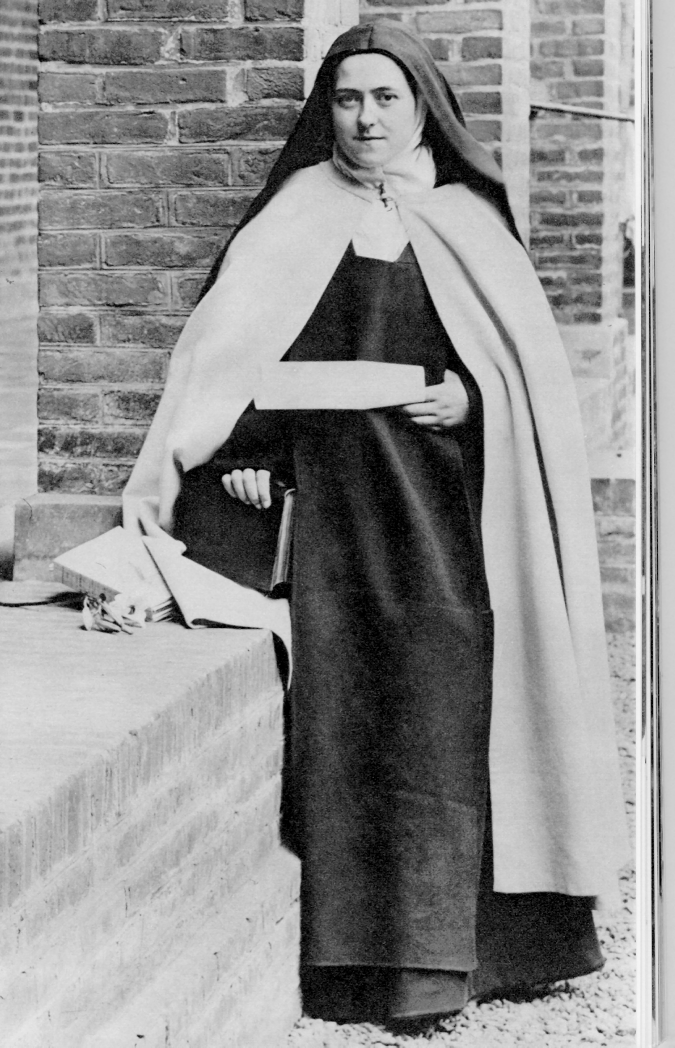
What is of primary importance, forming the very substance of her doctorate, is not so much what she says, but first and foremost what she lives—her life embodies the Gospel according to Saint John of the Cross, and this carries the highest significance in her doctorate. She lives the doctrine of Saint John of the Cross in all its fullness. In this sense, her doctorate occupies a place that is both unique and eminent. Her doctorate combines that of Saint John of the Cross (and of Saint Teresa of Jesus) and offers it in the form of a life, a complete realisation, with discernment and shedding new lights.
Furthermore, as Father Louis says, through her, God provides us with highly significant insights into life after union with God, into zeal, and into participation in salvation. Moreover, as Father Louis again affirms, she shows us Mary—the common way, the highest path—lived in the most ordinary of lives.
In this sense, her doctorate, being of a unique nature, raises her to a central position among the Doctors of the Church.
Yes, to be a Doctor of the Church, “eminent holiness” is required—this is one of the conditions. In the case of Saint Thérèse of the Child Jesus, her holiness is certainly eminent, but beyond that, it is exemplary (she is given as an example to follow); it is the “standard measure” of discernment—always within her incarnation of the doctrine of Saint John of the Cross. It is an eminent holiness made accessible to all, a common evangelical path. It is eminence for all. God has given her to us as an example, as if Mary herself had been given to us in a way that we, too, might incarnate her!
Who can truly understand this?

The diagram above illustrates a possible way of understanding St. Thérèse’s Doctorate. At the center of the triangle is Jesus—the Gospel. Thérèse draws us to Jesus; her life and doctrine embody a return to the Gospel. The Gospel, in turn, is lived to perfection by Our Lady, the perfect disciple of Jesus. Additionally, the profound teaching of St. John of the Cross offers a deep understanding of the Gospel and of Jesus’ gift to us. Both Mary and St. John of the Cross represent ideals—an “idealistic” or perfect way of living and understanding the Gospel.
Thérèse was sent to show us that the way of Mary and the doctrine of St. John of the Cross can indeed be lived to perfection. For this, she provides essential points of discernment. A central aspect of her teaching is that she never sought visions or spiritual consolations, knowing that such experiences are not essential for faith in this life. When, toward the end of her life, one of her sisters challenged her regarding her poems and her love for St. John of the Cross, she replied that what truly mattered was that the reality of faith was alive deep within her. This is a fundamental point of discernment.
Furthermore, Thérèse chose to live in a way accessible to all, without extraordinary graces or extreme penances. The way of spiritual childhood, which she taught, provides a secure path for living the life of Mary and embodying the teachings of St. John of the Cross. Another striking element of her journey is that she underwent the profound purification described in The Dark Night (Book II), despite never having read it. She was only familiar with The Spiritual Canticle and The Living Flame of Love. Yet, from her letters to her sister Céline, we can discern an incredible way of living the Dark Night from a uniquely different perspective—a true gift to the Church.
Thérèse also offers profound insights into zeal for the salvation of souls. Her Act of Oblation, Manuscript B, and the conclusion of Manuscript C reveal a deeply transformative yet simple way of living the heights of love described by St. John of the Cross in The Living Flame of Love. Her final trial adds significantly to spiritual theology, showing that after union with Jesus, one is called to follow Him into His Passion, actively participating in the application of His salvation to others.
All these elements form an essential part of her incarnation of St. John of the Cross’ teaching and of Our Lady’s own life. Ultimately, Thérèse’s Doctorate demonstrates that these extraordinary ideals are not only admirable but truly incarnable—they can be lived by each one of us.
Spiritual Theology
Understanding the profound and striking significance of her Doctorate is one of the fundamental requirements for the renewal of spiritual theology.
Studying Thérèse as a standard benchmark case for spiritual theology is fundamental. Attempting to move back and forth between theory (John of the Cross, Teresa of Ávila, etc.) and practice in Saint Thérèse of the Child Jesus is essential to see how it takes shape, to discern what is necessary and what is superfluous, and to understand what holiness looks like. In this sense, the spiritual theology of tomorrow can only be built around Thérèse! Why so? For a very simple reason: she offers the “common way,” providing a discernment that excludes everything unnecessary for living:
1- Feeling and receiving consolations
2- Extraordinary graces
3- Extraordinary paths
4- What to do with human weaknesses
In this respect, she is a sure guide, a reliable example. Moreover, there is an abundance of information about her! She is one of the first saints for whom we have a wealth of information—details about her, information drawn from her own writings, and insights from those around her (from an external perspective).
Saint Thérèse of the Child Jesus is not an optional saint. She is by no means a dispensable or optional Doctor of the Church. Her doctorate is one of perfect and reliable example—an incarnation of Mary, the absolute model of the disciple.
Many Christians, many theologians, and especially specialists in spiritual theology, do not realise the place of Thérèse in spiritual theology. Their spiritual and intellectual journey has not yet led them to encounter Thérèse. Meeting her is an immense grace and a decisive turning point.
Many also who think they know her may reach a certain point in this knowledge and stop. Ceasing to explore her is also a risk. Believing that one has passed through all the stages of knowing her is a constant danger.
Read also