
Jean Khoury
Summary: To understand Saint Francis of Assisi in depth, one guiding thread illumines the whole of his life: his desire for martyrdom, and what the Lord did with it. Three times, deliberately and at real risk to his life, Francis placed himself in circumstances that could have ended in a martyr’s death — sailing toward Syria, walking toward Morocco, and standing before the Sultan of Egypt — and three times he was, in the words of the sources themselves, “prevented by divine disposition.” What the sword of the infidel never granted him, the Lord granted by another way: two years before his death, on the bare rock of La Verna, Francis received in his own flesh the wounds of the Crucified. This article follows that single trajectory — desire, refusal, and fulfilment — through the principal early witnesses to Francis’s life: the two Lives of Thomas of Celano, the Major and Minor Legends of Saint Bonaventure, and the Chronicle of the Seven Tribulations of Angelo Clareno. It closes with practical conclusions for those who, today, wish to walk the way that Francis walked.
Introduction
Hagiography can be read in many keys. But for Francis of Assisi, one thread, once seen, cannot be unseen: from the early years of his conversion to the last two years of his life, Francis burned with an actual, concrete, repeatedly acted-upon desire to shed his blood for Christ. He did not merely admire the martyrs from a distance; he went, three separate times, to place himself before those who could kill him for his faith. Each time, “by divine disposition,” he failed. And it was precisely there — in that threefold, humanly incomprehensible failure — that the Lord was preparing something Francis could not have designed for himself: a fourth and final configuration to Christ, wrought not by the sword but by the fire of a Seraph, imprinted upon his living body on Mount La Verna.
This trajectory is, in itself, an inexhaustible vein of insight into what constitutes sanctity. It teaches that desire offered to God is never wasted, even — especially — when it is refused its object; that discernment of God’s will is worked out concretely, on one’s knees, before an open Gospel; and that the deepest identification with Christ crucified may come not through what we choose for ourselves, but through what God reserves for us once He sees that our will is entirely surrendered.
The central thesis this article seeks to establish is this: the desire for martyrdom in Saint Francis is answered by the grace of La Verna. To have a share in martyrdom is, at its deepest, to have a share in the work of salvation — and that share does not require a swift death. The mystery of the Stigmata of La Verna is, in itself, a Passion: a real participation in the Passion of Christ, and, through it, in the salvation of others. Read in this light, Francis’s own journey to holiness becomes paradigmatic of every journey to holiness: it leads, in the end, not merely to imitating Christ from without, but to participating in His Passio from within.
The material gathered below follows the principal sources of the early Franciscan tradition: Thomas of Celano’s Vita Prima (First Life of Saint Francis, 1228–1229) and Vita Seconda (Second Life, 1247); Bonaventure of Bagnoregio’s Legenda Maior (Major Legend, 1260–1263) and Legenda Minor (its liturgical abridgement); and the Chronicle of the Seven Tribulations of the Order of Friars Minor by Angelo Clareno (early fourteenth century). Each citation gives the source, its traditional section number, and, in brackets, the reference number of the Fonti Francescane (FF), the standard critical edition of the early Franciscan sources, following the text supplied for this study.
I. The Root of the Desire: “To Reach the Summit of Holiness”
Even before any specific attempt at martyrdom is recorded, Thomas of Celano locates in Francis a fundamental orientation of soul. “Animated by an ardent love of God,” he writes, “the most blessed father Francis always desired to set his hand to great undertakings, and, walking with a generous heart the way of the will of the Lord, he longed to reach the summit of holiness” (Thomas of Celano, Vita Prima, ch. XX, n. 55 [FF 417]). This longing for “the summit” is the seedbed from which the desire for martyrdom will grow: it is not first a desire to die, but a desire for the fullness of holiness — a fullness which Francis, reading his age’s theology of sanctity through the Gospel and the Cross, understood to find its most radical expression in laying down one’s life for Christ.
The concrete origin of the missionary vocation that would carry this desire across seas and deserts is dated precisely. On the feast of Saint Matthias, 24 February 1208, hearing that day’s Gospel, Francis was struck by the words with which Christ addressed the apostles, “sending them into the world” (Chronology). From that day he set aside his hermit’s habit, put on a rough tunic girt with a cord, and, barefoot, began to proclaim penance — the itinerant, missionary form of life that would, within a few years, carry him toward the frontier of martyrdom itself.
II. First Attempt: Toward Syria, Turned Aside to Slavonia (1211)
“In the sixth year of his conversion,” Celano continues, Francis, “burning with an unquenchable desire for martyrdom, decided to go to Syria, to preach the faith and penance to the Saracens” (Vita Prima, ch. XX, n. 56 [FF 418]). He embarked; contrary winds drove the ship instead to the coast of Dalmatia. “Disappointed in his ardent desire,” and finding no other vessel bound for Syria that year, he was reduced to begging passage home with a party of sailors headed for Ancona (Vita Prima, n. 56 [FF 418]).
Bonaventure’s later account of the same episode uses the identical vocabulary of fire: “in the sixth year from his conversion,” he writes, Francis, “inflamed by the desire for martyrdom, decided to cross the sea and go to the region of Syria, to preach the Christian faith and penance to the Saracens and other infidels” (Bonaventure, Legenda Maior, ch. IX, n. 6 [FF 1170]). What matters here is not the geography but the vocabulary the two independent witnesses choose, half a generation apart: “unquenchable desire,” “burning,” “inflamed.” This is not a passing wish. Francis will act upon it again.
III. Second Attempt: Toward Morocco, Stopped at the Gate of Spain (1213–1214)
Even the extraordinary fruitfulness of his preaching in the years that followed — Celano compares Francis to the Gospel tree that produces “abundant and exquisite fruit” — could not extinguish in him “the sublime purpose and the burning longing for martyrdom” (Vita Prima, n. 56 [FF 420]). So he set out for Morocco, to announce the Gospel to the Miramolino — the Almohad ruler — and his people. “So intense was his apostolic desire,” Celano notes, “that he sometimes left his companion behind, hastening in the ebriety of the spirit to carry out his purpose” (Vita Prima, n. 56 [FF 420]). Yet — as Celano, himself among the friars at the time, writes with evident personal feeling — “the goodness of God… made things turn out otherwise”: illness struck Francis in Spain and forced him to abandon the journey (Vita Prima, n. 56 [FF 420]).
Bonaventure narrates the same failed attempt and names explicitly what was at stake. Francis, he writes, “could not yet find peace until he had put into effect, with even bolder attempts, his burning dream” (Legenda Maior, n. 6 [FF 1171]). It was “the merit of dying for Christ” that he “yearned for above every other virtuous and meritorious work”; it was “the fruit of martyrdom” that “attracted him most”; he wished, Bonaventure says, “to win the longed-for palm of the martyrs” (Legenda Maior, n. 6 [FF 1171]). “Driven by so intense a desire,” he adds, “that, though physically weak, he outran his travelling companion — eager to fulfil his purpose, he flew, as it were, in an ebriety of spirit” (Legenda Maior, n. 6 [FF 1171]).
It was in Spain that illness intervened a second time. Bonaventure reads the providence at work here with striking clarity: God, “who reserved him for other tasks… made his desires vanish” (Legenda Maior, n. 6 [FF 1171]). And here comes the crucial theological turn: “the man of God understood, then, that his life was still necessary to his sons,” and though he judged death “a gain,” he turned back “to feed the sheep entrusted to his care” (Legenda Maior, n. 6 [FF 1171]). Already the pattern that will recur is visible: Francis’s desire is real and God-given, yet God’s providence, for a season, has other plans — plans that do not cancel the desire but hold it in reserve.
IV. Third Attempt: Before the Sultan of Egypt (1219)
The following year, in January 1220, five friars whom Francis had sent to Morocco were put to death there by the Muslim authorities — the protomartyrs of the Franciscan Order, the very martyrdom Francis himself had twice already set out to seek and twice been prevented from obtaining. “When Francis received the news,” the sources record, “he pronounced the profound words that explain his whole ideal: ‘Now I can truly say that I have five brothers'” (Chronology, citing Lortz, Storia della Chiesa, I, 529, n. 317). It is a startling exclamation, and a deliberate one: only now, seeing five of his own sons shed their blood for Christ, does Francis declare that his young Order has finally borne “true” Lesser Brothers — as though the fraternity he had founded found its own fulfilment only in the blood of martyrdom he himself had been seeking all along.
Celano’s own First Life gives the earliest surviving account of this third journey. Having returned to the Portiuncula after the Spanish illness and welcomed a number of learned and noble men into the Order, “Francis still could not find peace until he had carried out, with even bolder attempts, his burning dream” (Vita Prima, ch. XX, n. 57 [FF 422]). “In the thirteenth year of his conversion” — 1219 — “he set out for Syria,” crossed into the presence of the Sultan despite being seized, insulted and beaten by his guards, and was received, to everyone’s astonishment, “with great honour.” The Sultan offered him rich gifts, which Francis refused as so much rubbish, and Celano closes the episode with a sentence that already contains, in its earliest form, the whole theology this article traces: “But in all these things the Lord did not grant the fulfilment of the Saint’s desire, reserving for him the privilege of a singular grace” (Vita Prima, n. 57 [FF 423]).
Bonaventure’s Legenda Maior, writing a generation later, gives the fuller and now more familiar account. “The ardour of charity urged him on” a third time, “so that he attempted to set out for the lands of the infidels, in order to spread, with the shedding of his own blood, faith in the Trinity” (Legenda Maior, ch. IX, n. 7 [FF 1172]). Taking with him a companion named Illuminato, he crossed the lines between the crusader and Muslim armies at Damietta — an act of near-suicidal audacity, since the Sultan had decreed a gold bezant for the head of any Christian — and was brought, bound and beaten, into the presence of Malik al-Kamil, Sultan of Babylon.
There Francis proposed an ordeal by fire: he would enter the flames together with the Sultan’s priests, so that all might see “which faith ought, with good reason, to be held more certain and more holy” than the other — the Gospel, or “the law of Muhammad” (Legenda Maior, n. 8 [FF 1174]). No priest would come forward; the Sultan himself confessed that he did not believe any of his priests “would be willing to expose themselves to fire or to face torture to defend their faith” (Legenda Maior, n. 8 [FF 1174]). The Sultan declined the challenge for fear of sedition among his people. “Seeing, moreover, that he was making no progress in the conversion of that people, and that he could not accomplish his dream, forewarned by a divine revelation, he returned to Christian lands” (Legenda Maior, n. 9 [FF 1175]).
A further detail, preserved a century later in Angelo Clareno’s Chronicle of the Seven Tribulations, shows the encounter was not entirely without visible fruit: moved by Francis’s fervour, the Sultan “gave order that he and all his friars might freely go to the sepulchre” of Christ, “without paying” any tribute (Angelo Clareno, Chronicle of the Seven Tribulations, Tribulation II, n. 1 [FF 2154]) — a small, lasting concession wrested from a meeting that, judged by its stated purpose, had failed.
V. The Theology of a Desire Refused
What is remarkable is how consistently, and almost verbatim, the whole Franciscan tradition reads this threefold failure. Celano’s Vita Prima, writing within two years of Francis’s death, already supplies the formula: “the Lord did not grant the fulfilment of the Saint’s desire, reserving for him the privilege of a singular grace” (Vita Prima, n. 57 [FF 423]). A generation later, Bonaventure closes his own narrative of the Sultan encounter with an almost identical sentence: “the friend of Christ sought with all his strength to die for Him, and was quite unable to succeed. And in this way, on the one hand he did not lack the merit of the martyrdom he had desired, and on the other, he was spared, to be later honoured with an extraordinary privilege” (Legenda Maior, n. 9 [FF 1175]). Bonaventure then breaks into direct address: “O man truly and fully blessed, who ‘did not lose his life beneath the sword of the persecutor, yet did not lose the palm of martyrdom!’” (Legenda Maior, n. 9 [FF 1175]).
Bonaventure’s own Minor Legend condenses the entire itinerary into a single sentence that could stand as the thesis of this whole study: “regarding the fervour of perfect charity, by which the friend of the Bridegroom felt himself carried into God, everyone can verify it above all from this: he ardently longed to immolate himself, a living victim, in the flame of martyrdom” (Legenda Minor, lesson IX [FF 1356]). “Three times, for this reason, he set out on the road toward the lands of the infidels,” but twice was “prevented by divine disposition”; the third time, after chains, blows and countless hardships, he was led before the Sultan of Babylon and, having done “all that he could do” to obtain martyrdom, returned — for “the friend of Christ sought with all his strength to die for Him, and could not at all succeed. In this way, on the one hand he did not lack the merit of the martyrdom he had desired, and on the other, he was spared, to be later honoured with a singular privilege” (Legenda Minor, lesson IX [FF 1356]).
The Chronicle of the Seven Tribulations preserves the same reading with one clause worth pausing over. Francis, Angelo Clareno writes, “driven by the fervour of seraphic charity, by which he was wholly drawn into Christ, ardently desiring to offer himself to God as a living victim through the flame of martyrdom, undertook the journey toward the lands of the Infidels a full three times.” But twice he was prevented “by divine disposition, God wishing to test more fully the flame of his fervour” (Chronicle of the Seven Tribulations, Tribulation II, n. 1 [FF 2154]). This clause — “to test more fully the flame of his fervour” — reframes the whole sequence: the refusals are not obstacles God merely tolerates; they are themselves part of a purification, a testing of the very desire Francis lays on the altar.
VI. The Discernment Before the Open Gospel
Interwoven with this history of thwarted journeys is a quieter episode that shows how Francis came to understand what God actually willed for him. Celano gives it its own chapter, entitled, in his own words, “Francis’s Greatest Desire, and How, Opening the Book of the Gospel, He Knew the Will of God Concerning Him” (Vita Prima, ch. II, title [FF 479]). Desiring “to occupy himself only with God and to purify his spirit” of whatever dust the world might have left on him, Francis “withdrew to a place of recollection and silence,” taking with him only his closest companions (Vita Prima, n. 91 [FF 479]). There, in prolonged prayer, he came to an extraordinary intimacy with God and longed to know “what in him, and of him, might be most pleasing to the eternal King” (Vita Prima, n. 91 [FF 479]).
The text goes on to describe, in the very passage the source itself marks out for special attention, the singular focus of that longing: Francis “studied with all his mind and with all his love to know what way and what path might be best suited to reach an ever more perfect union with the Lord God, according to the plan and decree of His will. And this was always his one philosophy, his supreme desire, in which he burned as long as he lived; and he asked everyone, the simple as much as the wise, the perfect as much as the imperfect, how he might reach the way of truth and arrive at ever higher goals” (Vita Prima, ch. II, n. 92 [FF 480]).
To settle the question, Francis went to the altar of the hermitage, laid the Gospel book upon it, and, prostrate in prayer, “begged and implored” God to reveal to him, at the book’s first opening, “what he ought to do” (Vita Prima, n. 93 [FF 482]). Rising, he opened the book: the first thing his eyes fell upon was “the passion of our Lord Jesus Christ,” in the place where it is foretold (Vita Prima, n. 93 [FF 483]). Fearing coincidence, “he closed and reopened the book a second and a third time,” and each time the same passage, or one like it, appeared (Vita Prima, n. 93 [FF 483]). Celano draws the conclusion himself: Francis understood “that he would enter the Kingdom of Heaven only through countless tribulations, hardships and struggles” — and was not troubled by the thought (Vita Prima, n. 93 [FF 483]).
This episode gives theological weight to the whole trajectory of failed journeys. Francis’s road toward martyrdom was never a private enthusiasm bolted onto an otherwise ordinary conversion; it was discerned, on his knees, before the very Word of God, opened three times over an altar, before he ever set foot on a ship.
VII. Martyrdom as the Object of the Highest Obedience
A saying preserved in Celano’s Second Life shows that, in Francis’s own mature teaching, the desire for martyrdom had become not merely a personal aspiration but a category of the spiritual life itself — specifically, of obedience. Distinguishing between obedience granted “on request” (which he called “licences”) and obedience that is commanded and not sought (which he called “holy obediences”), Francis judged the second the more secure of the two. But the most perfect obedience of all, he taught, “in which flesh and blood have no part whatsoever,” was “the obedience by which one goes, by divine inspiration, among the infidels — whether for the salvation of one’s neighbour, or out of desire for martyrdom. To ask for this, he judged a thing very pleasing to God” (Thomas of Celano, Vita Seconda, ch. CXII, n. 152 [FF 736]).
This is a striking piece of Franciscan spiritual theology. For Francis, the desire for martyrdom is not a private heroism to be indulged at will; it is a grace to be asked for within obedience — the highest form of obedience there is, precisely because it is entirely stripped of self-will.
VIII. The Fulfilment: The Fire of the Seraph on La Verna
Bonaventure’s ninth chapter of the Legenda Maior — titled, precisely, “Fervour of Charity and Desire for Martyrdom” (Legenda Maior, ch. IX, title [FF 1160]) — situates the three failed journeys within the larger movement of Francis’s ardent love of Christ crucified, “burning like a live coal,” seeking through every creature “the Beloved” (Legenda Maior, ch. IX, nn. 1–2 [FF 1161–1163]). It is this same fire, Bonaventure says explicitly, that both drove Francis toward the infidels and — since it could not be spent in blood — had at last to be spent another way: “inflamed by that perfect charity which casts out fear, he too longed to offer himself, a living victim, to the Lord, in the fire of martyrdom, both to repay Christ who dies for us, and to provoke others to the love of God” (Legenda Maior, ch. IX, n. 5 [FF 1169]).
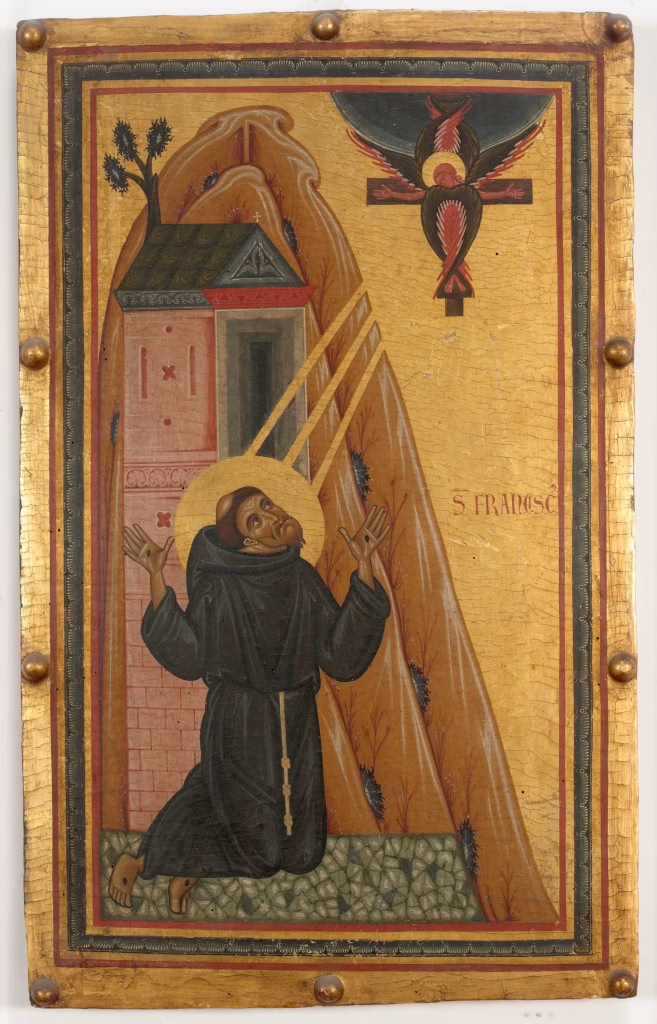
Two years before his death, on the mountain called La Verna, that longing was answered — not by the sword of any Sultan, but directly from heaven. Keeping his customary Lenten fast in honour of Saint Michael, Francis had a vision: a figure like a Seraph, six-winged and aflame, descended toward him, and between the wings appeared the likeness of a man crucified. “The seraphic ardour of his desire,” Bonaventure writes, “carried him up into God,” while “a tender feeling of compassion transformed him into Him who, out of excess of charity, willed to be crucified” (Legenda Maior, ch. XIII, n. 3 [FF 1225]). When the vision faded, Francis found in his own hands and feet “the same signs of the nails that he had just seen in that mysterious crucified man”; his right side, too, was pierced “as by a spear-thrust,” and often bled (Vita Prima, ch. III, nn. 94–95 [FF 484–486]).
Bonaventure’s theological reading of this event closes the circle opened by the three failed journeys. What Francis could not obtain through the martyrdom of the flesh, he received through the burning of the spirit. The wound the Sultan’s blade never inflicted was inflicted instead by the hand of God. The desire that three times crossed seas and mountains toward a human executioner was, in the end, answered by the one wound-giver who could truly conform him, body and soul, to the Crucified — the fulfilment, at last, of what Celano’s earliest biography had already named: “the privilege of a singular grace” (Vita Prima, n. 57 [FF 423]).
IX. Martyrdom as Participation in the Work of Salvation
It is worth pausing, at this point, on what the sources themselves say the desire for martyrdom was for. Bonaventure does not present it as a desire for death as such. Francis, he writes, longed “to offer himself, a living victim, to the Lord, in the fire of martyrdom, both to repay Christ who dies for us, and to provoke others to the love of God” (Legenda Maior, ch. IX, n. 5 [FF 1169]). Two ends are named, and neither is Francis’s own extinction: a repayment made to Christ on behalf of the world he died for, and a provocation — a kindling — of love in others. Martyrdom, on this reading, is never a private transaction between the martyr and God alone; it is a share in Christ’s own work of saving others.
This is why the grace of La Verna can, without any diminishment, answer a desire that had explicitly been for blood shed among the infidels. What Francis sought three times over was never, at bottom, a particular manner of dying; it was a share in the redemptive Passion of Christ, offered for the salvation of others. The Stigmata do not merely commemorate that Passion from the outside, as a picture or a relic would; they are impressed “in his flesh by the finger of the living God” (Legenda Maior, ch. XIII, n. 5, cf. [FF 1226]), borne in his own body, with its own hidden bleeding, for the last two years of his life. In this sense the Stigmata are not a consolation prize offered in place of martyrdom, but a Passion in themselves — a real and lasting participation in the Passion of the Lord, and, through it, in His work of salvation for others, exactly as the three failed journeys had sought to be.
Read in this light, Francis’s own trajectory — desire, threefold refusal, and consummation — becomes paradigmatic of the whole spiritual life, not merely of missionary heroism. The journey to holiness that every Christian is called to make is not, ultimately, a journey toward a single decisive act, however dramatic; it is a journey toward participating, in whatever form God allots, in the Passio of the Lord — borne, as Francis bore it, for the salvation of others.
Practical Conclusions for Those Who Follow the Way of Saint Francis
- A desire offered to God is never wasted, even when refused. Celano’s verdict — that Francis “did not lack the merit of the martyrdom he had desired” even though he never obtained it (Legenda Maior, n. 9 [FF 1175]) — is a principle for the whole spiritual life. What God asks of us is the offering; the outcome belongs to Him.
- Discernment of God’s will is worked out concretely, not merely felt. Francis did not presume to know God’s plan for him from an inner impression alone. He withdrew into silence, prayed at length, and sought confirmation three times over an open Gospel (Vita Prima, nn. 91–93 [FF 479–483]). Those who wish to walk his way should likewise anchor their discernment in Scripture and in sustained, humble prayer — what later tradition will call lectio divina.
- Providence may reserve us for tasks we did not choose. Twice, illness — an apparently ordinary, even humiliating, obstacle — stopped Francis in his tracks. Bonaventure reads this not as failure but as God “reserving him for other tasks,” because “his life was still necessary to his sons” (Legenda Maior, n. 6 [FF 1171]). The interruption of a desired path is not necessarily its refusal; it may be its redirection.
- The desire for martyrdom is, at root, the desire for the fullness of charity. Every source cited here traces the desire for martyrdom back to “the fervour of charity” (Legenda Maior, ch. IX, title [FF 1160]; Legenda Minor, lesson IX [FF 1356]; Chronicle of the Seven Tribulations [FF 2154]). Those who cannot travel to a mission field or face physical persecution can, and should, still cultivate that same fervour — the daily offering of self as “a living victim,” which is, in substance, the very offering Francis made three times over.
- The highest obedience surrenders even our holiest ambitions. Francis taught that the desire for martyrdom finds its proper form inside obedience, not outside or above it (Vita Seconda, n. 152 [FF 736]). Even the most exalted spiritual desire must be entrusted to a rule, a director, or a superior, rather than pursued unilaterally.
- Extraordinary graces are to be received in hiddenness. Francis concealed the Stigmata for as long as he could, revealing them only under pressure and to a very few (Legenda Maior, ch. XIII, nn. 4–8 [FF 1227–1232]). Anyone graced with unusual spiritual gifts should imitate this same instinct: not display, but concealment, for the sake of the gift’s own integrity.
Conclusion
Three times Francis of Assisi walked toward a martyr’s death, and three times, “by divine disposition,” the door closed before him. Read on its own, each failure might look like defeat. Read together, as Celano, Bonaventure and Angelo Clareno all read them, they form a single arc: the arc of a desire so pure that God chose not to satisfy it in the way Francis expected, but to satisfy it more completely than Francis could have imagined — by imprinting, two years before his death, the wounds of Christ crucified upon his living flesh. What the sword of the Sultan and the storms of Slavonia and Spain withheld, the Seraph of La Verna gave. Francis’s “one philosophy,” discerned before the open Gospel and asked for as the highest obedience, was, in the end, granted him not by his own effort but as pure gift. In that gift, as the whole Franciscan tradition insists with one voice, the friend of Christ was at last transformed into the very image of Him he had loved. Martyrdom, for Francis, was never merely a swift death sought and denied; it was a share in the work of salvation — and that share was given him, in full, on the mountain of La Verna, where the Stigmata became, in his own flesh, a Passion in itself. His journey to holiness is, in this, every Christian’s journey: it leads, finally, to a real participation in the Passio of the Lord.
References
Thomas of Celano, Vita Prima (Vita Beati Francisci — First Life of Saint Francis), 1228–1229.
Thomas of Celano, Vita Seconda (Memoriale in desiderio animae — Second Life of Saint Francis), 1247.
Bonaventure of Bagnoregio, Legenda Maior (Major Legend of Saint Francis), 1260–1263.
Bonaventure of Bagnoregio, Legenda Minor (Minor Legend, liturgical abridgement of the Major Legend).
Angelo Clareno, Cronaca delle sette tribolazioni dell’Ordine dei Frati Minori (Chronicle of the Seven Tribulations of the Order of Friars Minor), early fourteenth century.
All section references follow the numbering of the Fonti Francescane (FF), the standard critical collection of the early Franciscan sources, as marked in the Italian source text supplied for this study.